AI Leap 2025 (TI-Hüpe) — Estonia's National School AI-Literacy Rollout
Estonia
Estonia's AI Leap gives all grade 10-11 students and teachers free access to ChatGPT/Gemini-class AI tools plus mandatory teacher AI-literacy …
Armenia · Yerevan · See the Armenia profile · See the Yerevan profile
Evidence: Descriptive / self-reported Top 56% 47/100 · Ask Evidence Copilot about this practice
Tuition-free after-school program for teens 12-18 founded in Yerevan in 2011; now reaches over 60,000 learners weekly across 27+ centers in 13+ countries. Its AI Colearner platform won first place ($500,000) in the 2025 WISE Prize for Education, chosen from 427 applicants.
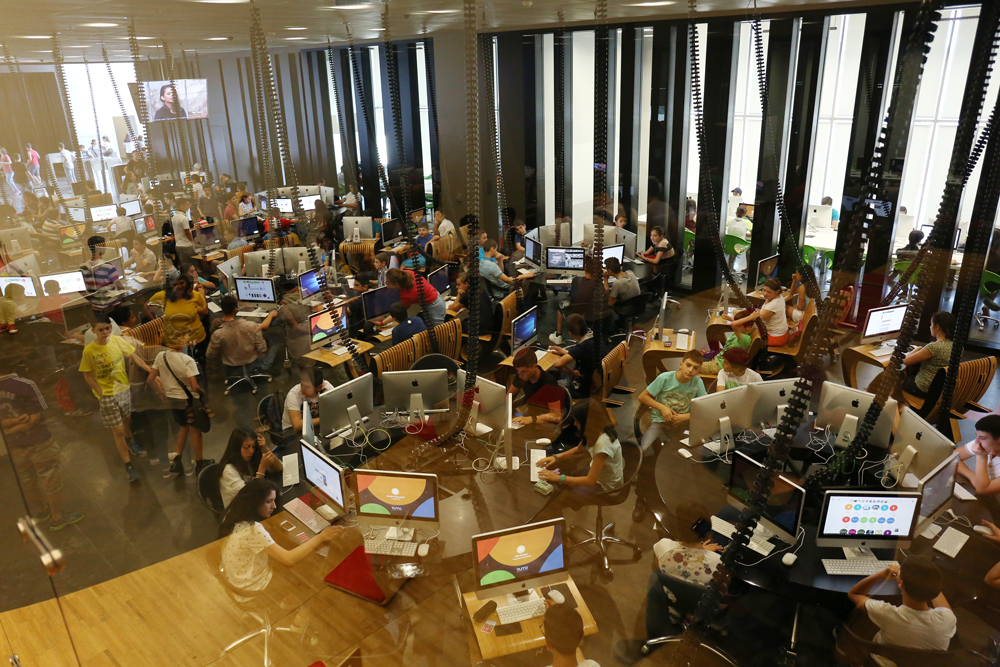
TUMO Center for Creative Technologies is a tuition-free, nonprofit after-school program founded in 2011 in Yerevan, Armenia by Sam and Sylva Simonian, funded through the Simonian Educational Foundation. It offers self-directed digital activities, instructor-led workshops, and project-based learning labs to teenagers aged 12-18 across 14 subject areas including programming, robotics, filmmaking, game development, and, since 2024, generative AI.
Provide free access to creative-technology and, more recently, AI/GenAI skills education to teenagers regardless of entrance exams, tuition fees, or grades, including in rural areas.
Learners progress through a three-layer model: self-directed digital activities, instructor-led workshops, and project-based learning labs. In 2024 TUMO launched an 'AI Colearner' platform using a conversational AI peer ('Colo') to support learning. TUMO also runs 40+ mobile 'TUMO Box' hubs to extend reach into rural areas, and has expanded to 27+ centers across 13+ countries.
TUMO reaches over 60,000 learners weekly and has served 60,000+ alumni to date. In 2025 the program won first place and a $500,000 prize in the WISE Prize for Education, selected from 427 applicants, with an advisory board rating its impact 'Exceptional' and its scalability 'High'.
No disaggregated outcome data by income or disability has been published, and no AI-ethics or data-privacy framework for the new GenAI 'Colearner' platform was identified in available sources; the evidence base is participation scale and jury assessment rather than a controlled study of learning outcomes.
Philanthropic / foundation funding
Indicative funding routes for practices of this type — always check each programme's current calls and eligibility rules.
Do you run this practice? Claim it — verified implementers get a public contact pathway and can propose corrections.
Where this practice's information was retrieved from, and when.
Estonia
Estonia's AI Leap gives all grade 10-11 students and teachers free access to ChatGPT/Gemini-class AI tools plus mandatory teacher AI-literacy …
Poland
Poland's Copernicus Science Centre and Ministry of National Education are running ZBADAI, training 930 teachers and 13,000 students across 200 …
Bosnia and Herzegovina
Under the EU-funded EU4Education and Employment project, the ILO trained 170+ vocational teachers across Bosnia and Herzegovina in a five-month …
Italy
Italy's arm of the Erasmus+ AI4T trial gave maths and language teachers a fully online, tutor-led AI pathway; a school-randomised …
Open full copilot Grounded in cited practices — always check the sources.