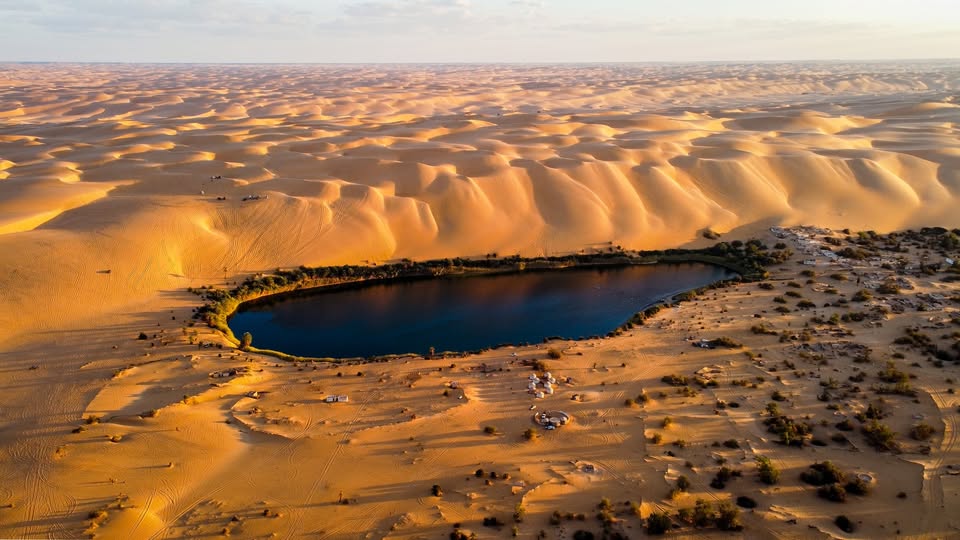
A $5.8M GEF-UNDP programme approved Dec 2025 will rehabilitate 225 ha of degraded lake, wetland and oasis ecosystems in Libya's Ubari Lakes basin, extend climate-resilient water management to 2,000 ha, and lay groundwork for a 100,000-ha national park.
5.8 US$ million
GEF grant approved (December 2025)
225 hectares
Degraded ecosystems to be rehabilitated (2025-2030)
2,000 hectares
Land under climate-resilient water management (target) (2025-2030)
100,000 hectares
Proposed national park area
2,250+ people
People targeted for livelihood diversification (2025-2030)
700 jobs (approx.)
New jobs targeted (2025-2030)
Details
Maturity
Pilot
Promoter
Libyan Ministry of Environment, with UNDP and GEF support
Period
2025–2030
Keywords
land management, water management, wetland restoration, protected areas
Context
The Ubari Lakes basin, a cluster of saline lakes and oases in the Sahara desert of Libya's Fezzan region, has been degraded by more than a decade of conflict-related neglect, groundwater overuse and unmanaged land use.
Objectives
In December 2025 the Global Environment Facility (GEF) Council approved a $5.8 million grant for 'Integrated Land and Water Management (ILWM) for Enhanced Ecosystem Goods and Services in Libya,' to be executed by Libya's Ministry of Environment with UNDP support, aiming over five years to rehabilitate 225 hectares of degraded lake, wetland and oasis ecosystems, extend sustainable, climate-resilient land and water management across 2,000 hectares, and support the legal groundwork for a proposed 100,000-hectare Ubari Lakes National Park.
Activities
The programme targets livelihood diversification for more than 2,250 people, at least half of them women, through around 700 new jobs in eco-tourism, sustainable agriculture, oasis restoration and climate-smart micro-enterprises.
Conclusions
Because the initiative was only approved in December 2025, it has not yet produced independently verified field results; its value at this stage lies in formal institutional commitment — GEF Council approval and ministry ownership — and clearly quantified targets rather than demonstrated outcomes.
Implementation
Indicative cost
Medium (€50k–€500k) — $5.8 million GEF grant approved December 2025, executed by Libya's Ministry of Environment with UNDP support.
Time to results
Medium (1–3 years) — Five-year implementation planned, 2025-2030.
Formal GEF Council approval and named ministry ownership before implementation begins
Clear, quantified five-year targets for hectares rehabilitated and jobs created
A legal pathway toward a 100,000-hectare national park to lock in long-term protection
Common failure modes
The programme was approved only in December 2025 in a country with over a decade of conflict-related institutional disruption, so implementation capacity is untested
No field results exist yet to confirm the ambitious hectare and livelihood targets will be met
Where it fits
Governance type
national ministry with GEF/UNDP international support
Scale
regional (basin-wide, 225 ha initial rehabilitation within a proposed 100,000 ha park)
Income level
upper-middle-income (fragile/conflict-affected)
Do you run this practice?
Claim it —
verified implementers get a public contact pathway and can propose corrections.
Data sources
Where this practice's information was retrieved from, and when.
Kigali is rehabilitating five degraded urban wetlands (491 ha: Gikondo, Rwampara, Nyabugogo Lower, Kibumba, Rugenge-Rwintare) into flood-control eco-parks under a …
A UNDP/GEF project (~US$900,000) is restoring wetland hydrology across 20,803 ha of Moldova's Lower Prut Biosphere Reserve; rehabilitating the Camenca …