Leefstraat (Living Streets) Ghent — A Citizen-Led Public-Space Living Lab
Belgium
Since 2012, Ghent has let residents vote each year to temporarily close their street to cars and redesign it together. …
Netherlands · Utrecht · See the Netherlands profile · See the Utrecht profile
Evidence: Descriptive / self-reported Top 63% 62/100 · Ask Evidence Copilot about this practice
In January 2021 Utrecht's council adopted the Ruimtelijke Strategie Utrecht 2040, committing roughly €7.1 billion to build four new urban centres so daily needs stay within a 10-minute walk, cycle or transit ride as the city grows from 355,000 to 455,000 residents.
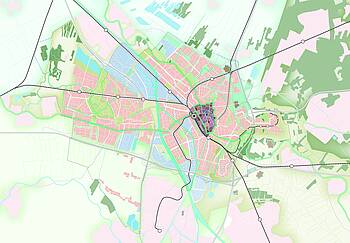
NL31Utrecht's Spatial Strategy 2040 ('ten-minute city' / 'tien-minutenstad'), adopted in 2021 by the city council with support from Dutch urban design bureau De Zwarte Hond, responds to projected growth from roughly 355,000 to 455,000 residents by 2040, needing at least 60,000 extra dwellings and 70,000 additional jobs.
Move from a single-centre model to four new urban centres built around existing rail and tram hubs, alongside the historic centre, so daily needs stay within a 10-minute walk, cycle or transit ride.
Utrecht is building four new urban centres - Leidsche Rijn Centrum/Cartesius/Werkspoorkwartier, Overvecht, Utrecht Science Park/Rijnsweerd/Galgenwaard, and the A12-zone (Papendorp-Galecop-Westraven-Laagraven) - backed by an estimated 7.1 billion euro investment across mobility, green space, education, energy, sport, culture and healthcare. This is paired with mobility measures already underway: a city-wide 30km/h speed limit on all but a few arterial roads, and traffic studies showing roughly a quarter of vehicles on busy local roads were pure through-traffic with neither origin nor destination nearby.
The city-wide speed-limit change and mobility-plan groundwork are delivered and profiled as an EU Urban Mobility Observatory case study; the four new urban centres themselves remain largely unbuilt.
As a 2021-adopted, 2040-horizon strategy, most of the ten-minute-city vision remains unbuilt; large parts of the plan, including development of the Rijnenburg polder, are not expected to start before 2035.
ERDF — European Regional Development Fund InvestEU National / regional programmes
Indicative funding routes for practices of this type — always check each programme's current calls and eligibility rules.
Reusable artefacts from this practice — as published by their sources.
Do you run this practice? Claim it — verified implementers get a public contact pathway and can propose corrections.
Where this practice's information was retrieved from, and when.
Belgium
Since 2012, Ghent has let residents vote each year to temporarily close their street to cars and redesign it together. …
Germany
Freiburg turned a former barracks into a ~5,500-resident district with parking-free streets and edge-of-district garages; city data report 172 cars …
Spain
Barcelona closed street grids to through-traffic in pilot 'superblocks'; evaluated zones saw NO2 fall 24% and noise fall 5.4%. A …
Finland
Helsinki's city-owned innovation company co-creates smart-city, mobility and data solutions through agile pilots in real neighbourhoods (Smart Kalasatama, Jätkäsaari Mobility …
Open full copilot Grounded in cited practices — always check the sources.