National Peatland Rewetting Programme (Sweden)
Sweden
Sweden's government-funded wetland rewetting budget line restored 2,100 ha of drained land in 2023 alone (1,500 ha peatland, 588 projects), …
Iceland · Reykjavik · See the Iceland profile · See the Reykjavik profile
Evidence: Observational / pre–post Top 40% 47/100 · Ask Evidence Copilot about this practice
Since 2018, Iceland's Wetland Fund has rewetted ~300 ha of drained peatland and is piloting an IPCC-aligned carbon-credit methodology with automated water-level monitoring, tackling a resource behind up to two-thirds of Iceland's greenhouse gas emissions.
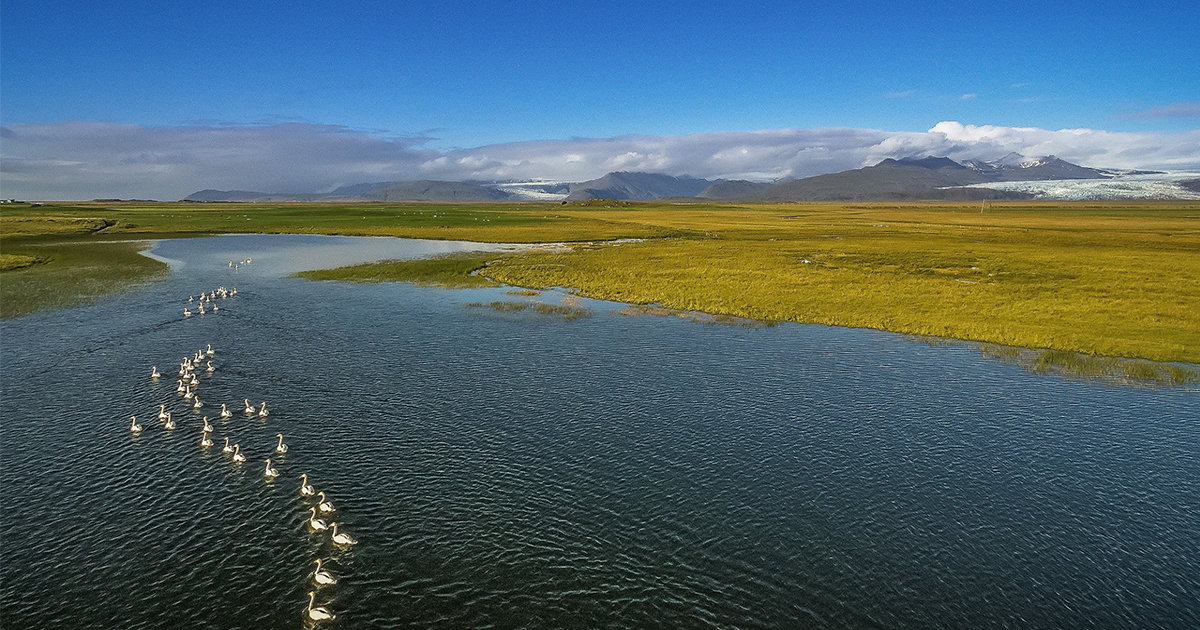
IS00Drained wetlands are Iceland's largest source of greenhouse gas emissions, responsible for up to two-thirds of the national total. The country has roughly 34,000 km of drainage ditches, dug mostly in the mid-20th century for agricultural expansion that in many cases never materialised. Votlendissjodur (the Icelandic Wetland Fund) was founded in 2018 to help landowners, farmers, municipalities and the state rewet peatland not used for cultivation or forestry, by financing the blocking of drainage ditches.
Rewet drained peatland to cut greenhouse gas emissions; Iceland's national strategy targets 5,300 hectares restored by 2026 and 15,600 hectares by 2031.
A carbon-credit pilot project uses an international wetland methodology aligned with IPCC guidance. Assessment rests on a two-year baseline monitoring period, with automated water-level loggers recording readings every five seconds; data is evaluated by the Soil Conservation Service of Iceland and reviewed by scientists from the Agricultural University of Iceland and the University of Iceland before any submission, with financial oversight from PwC.
Since 2018 the fund has restored close to 300 hectares of peatland.
Iceland's broader voluntary carbon market has faced credibility problems elsewhere, with other domestic offset ventures relying on indirect modelling rather than measured reductions, and some collapsing for lack of scientific grounding. Votlendissjodur's rigorous baseline-monitoring approach is comparatively strong, but the pilot has not yet issued or sold verified credits, and restoration to date remains far short of the national target (about 300 of 5,300 hectares).
National / regional programmes LIFE Programme
Indicative funding routes for practices of this type — always check each programme's current calls and eligibility rules.
Do you run this practice? Claim it — verified implementers get a public contact pathway and can propose corrections.
Where this practice's information was retrieved from, and when.
Sweden
Sweden's government-funded wetland rewetting budget line restored 2,100 ha of drained land in 2023 alone (1,500 ha peatland, 588 projects), …
Russia
After catastrophic 2010 peat fires blanketed Moscow in smog, the Moscow Province Administration rewetted 73,000 ha of fire-prone peatlands (2010-2013) …
Poland
The EU-funded LIFE Peat Restore project rewetted about 1,350 ha of degraded fen in Poland (part of 5,300 ha across …
Denmark
Denmark's June 2024 Green Tripartite Agreement commits a ~DKK 40bn (EUR 5.4bn) Green Land Fund to voluntarily rewet 140,000 ha …
Open full copilot Grounded in cited practices — always check the sources.