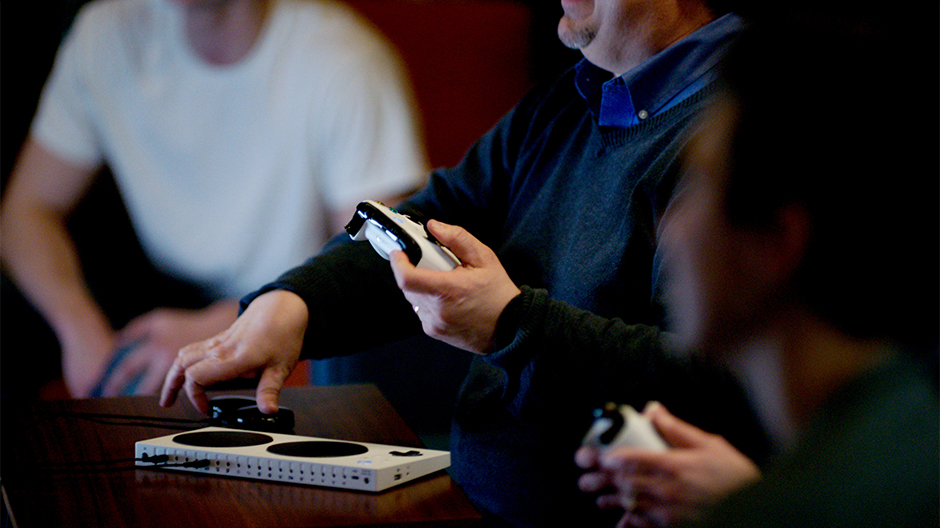
Microsoft co-designed the Xbox Adaptive Controller with five disability nonprofits, giving gamers limited mobility a modular base with 19 ports. Launched 2018 at $99.99, the model spread industry-wide: Sony's $89.99 Access Controller followed in 2023.
Gaming controllers had historically assumed a standard range of hand mobility and dexterity, excluding many players with limited mobility. In 2015, Microsoft employee and Warfighter Engaged member Matt Hite brought disabled military veterans to the company's internal One Week Hackathon, seeding what became the Xbox Adaptive Controller project.
Objectives
Design a mainstream, retail gaming controller that could be physically adapted to each player's own range of motion, rather than requiring players to adapt to a fixed controller layout.
Activities
Over three years, Microsoft's Xbox design and research teams worked directly with five disability organisations — The AbleGamers Charity, The Cerebral Palsy Foundation, Craig Hospital, SpecialEffect and Warfighter Engaged — to prototype and test a controller built around two large, low-resistance programmable buttons and 19 external 3.5mm jacks plus two USB ports, so players could plug in whatever switches, joysticks or buttons matched their own physical needs. The packaging itself went through more than 100 iterations with input from gamers with disabilities, including retail specialist Solomon Romney, to remove twist-ties and multi-step opening steps that were barriers on their own.
Results
Microsoft launched the Xbox Adaptive Controller on Global Accessibility Awareness Day, 17 May 2018, priced at $99.99. The co-design model proved transferable industry-wide: in 2023 Sony launched its own $89.99 PlayStation Access controller, developed in partnership with the same AbleGamers charity, and Nintendo licensed a comparable third-party controller (the Hori Flex) for Switch.
Conclusions
Independent comparisons note real design trade-offs rather than one universally 'best' answer: Sony's Access controller favours fewer ports (4) and more out-of-the-box usability, while the Xbox controller's more extensive 19-port expandability is more setup-dependent — a reminder that inclusive co-design choices involve genuine trade-offs.
Implementation
Indicative cost
High (€500k–€5M) — Three years of dedicated design/research team time plus five nonprofit partnerships and 100+ packaging prototype iterations before a 2018 retail launch.
Time to results
Medium (1–3 years) — Hackathon origin in 2015; co-design and prototyping through 2018 launch; industry follow-on effects (Sony, Nintendo) through 2023.
Staffing & skills
Microsoft Xbox design and research teams, The AbleGamers Charity, The Cerebral Palsy Foundation, Craig Hospital, SpecialEffect, Warfighter Engaged
Conditions for success
Direct, sustained co-design with disability nonprofits and disabled gamers/testers over multiple years
Iterative prototyping tested against real physical needs (100+ packaging redesigns)
Modular, plug-in architecture (19 ports) so the controller adapts to the player rather than the reverse
Common failure modes
Extensive port-based modularity is more setup-dependent than simpler rivals; Sony's later 4-port Access controller favoured out-of-the-box usability over expandability, showing no single design serves all users equally
Where it fits
Governance type
private-sector corporate R&D in partnership with disability nonprofits
Scale
global consumer product
Income level
high-income (US-based multinational)
Do you run this practice?
Claim it —
verified implementers get a public contact pathway and can propose corrections.
Data sources
Where this practice's information was retrieved from, and when.
Sony spent five years co-designing the Access controller with AbleGamers, Stack-Up and SpecialEffect and disabled gamers themselves, producing a modular, …