Top 43%
in this catalogue (1040 scored practices)
Scores cluster high, so position within the catalogue is often more telling than the number alone.
Transferability / replicability2/3
The curriculum, adapted from South Africa's Stepping Stones, was itself subsequently piloted in Nepal with similarly promising results, though only two country adaptations are documented.
Impact on gender equality1/1
Women's reports of any past-year intimate-partner violence nearly halved, from 66.4% to 37.2%, sustained to the 30-month endline.
Effectiveness1/1
All reported reductions in IPV measures were statistically significant (p<0.001–0.008) across four repeated survey rounds.
Efficiency0/1
No cost or cost-per-outcome data were published alongside the evaluation.
Evaluated outcomes1/1
A mixed-methods evaluation surveyed the same families at baseline and at 8, 15 and 30 months using regression models adjusted for age.
Sustainability0/1
The evaluated cohort was a single 80-family, four-village pilot with no control group and no documented institutional scale-up.
Achievement / evidence1/1
Beyond violence reduction, the programme also documented large gains in women's income (17.9%→56.6%) and mental health (CES-D score 28.5→13.6).
Gender-mainstreaming embedding1/1
The intervention explicitly combines gender-norms dialogue with joint male-female and two-generation family participation to shift household power dynamics.
Curator validation1/1
Figures were verified against the peer-reviewed Global Health Action article and the International Alert evaluation report.
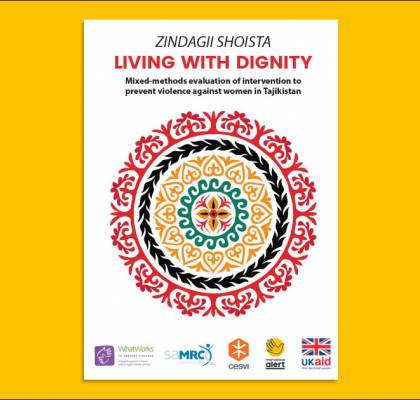
Evidoria. Zindagii Shoista (Living with Dignity) — Family-Level Violence Prevention in Rural Tajikistan. Persistent ID: 093ccd84-473c-43b8-afc3-4c9afe5f7adb.