Parque Nacional de Diawling — Reinundação Artificial do Delta do Rio Senegal (Mauritânia)
Mauritânia
Criado para compensar a interrupção do caudal causada pelas barragens de Diama e Manantali, o sistema de diques e comportas …
Alemanha · Ver o perfil de Alemanha
Evidência: Descritivo / autorreportado · Pergunte a Evidence Copilot sobre esta prática
None
DE300Berlin climate is temperate, with a significant urban heat island effect, which can raise the temperature by up to 4ºC relative to surrounding areas. While there is much uncertainty about the precise impacts of climate change on the city, scenarios indicate that temperatures will be higher, extreme weather events like heatwaves and intense rain and hailstorms will be more frequent, air pollution will increase, and there will be a water shortage (the latter despite extensive sources of freshwater in the city, due to longer, drier periods without precipitation, increased water consumption, and the diversion of water further upstream). The frequency of heatwaves in particular is expected to increase as a result of climate change, to up to 2 events every 33 years in 2050 and up to 12 events every 33 years by the end of the century under the RCP 8.5 ( Climate Adapt, Urban Adaptation Map Viewer ). These changes in climate are expected to have negative impacts on the population, especially considering that Berlin's city centre is characterized by a high density of construction. Intensively used urban areas are affected by: A high degree of soil sealing, resulting from the increase in built up areas and impermeable surfaces; Inadequate replenishment of the groundwater, due to the rapid runoff of rainfall into the sewage system; Excessive warming and lack of humidity; A constant decrease in biodiversity, due to limited extension of green space.
The BAF contributes to the following adaptation and environmental quality goals: Safeguarding and improving the microclimate and air quality, reducing the urban heat island effect and therefore reducing vulnerability to heatwaves; Preserving and enhancing soil functions and the water balance, reducing vulnerability to extreme precipitation events and related run-off. Creating and enhancing the quality of habitats for plant and animals; Improving the residential environment.
The Biotope Area Factor establishes that the development of new buildings requires a proportion of the area to be left as a green space. The BAF provides developers, architects and designers with clear but flexible guidelines on the portion of the plot of land that must be planted or provide other green space functions in terms of: improvement of the microclimate, urban cooling, sustainable drainage, improvement of natural habitats and enhancement of the quality of the residential environment. Specific solutions implemented in the BAF include: (i) greening of functional spaces (e.g. bike or bin sheds); (ii) planting trees and shrubs or, in smaller areas, climbing plants to create green walls; (iii) introducing green roofs; (iv) paving restricted to main routes and use of permeable surfaces elsewhere. These measures reduce radiation fluxes, provide shade, provide a cooling effect inside buildings and outside, improve air and water quality, and improve the proper management of storm-water run-off. The strength of the BAF concept is that it allows flexibility of the site design: the developer may decide what green space measures are applied, and where, as long as the required green space ratio is achieved. The BAF formula calculates the proportion of an area that needs to be green space: BAF = Ecologically Effective Surface Areas/Total Land Area. BAF targets depend on the specific uses of an area. The Ecologically Effective Surface Areas is a weighted sum of the areas belonging to the different categories foreseen in the measure, where weighting factors capture the different “ecological values” of these categories. Different types of green spaces are weighted differently according to these “ecological value”, which are based on evapotranspiration capacity, permeability, possibility to store rainwater, relationship to soil functioning and provision of habitat for plants and animals. For example, the weighting factor of a sealed asphalt surface is 0; that of extensive green roofs is 0.5; that of surfaces with vegetation connected to soil below is 1. Residential and public areas need to achieve a BAF target of 0.6 while commercial, business and administrative areas are requested to achieve a lower target of 0.3. Since December 2019, the prescribed weighting factors for vertical greenery and roof greening has undergone the following refinements: vertical greenery without connection to the ground: 0.7 per m 2 ; extensive roof greening: 0.5 per m 2 ; semi-intensive roof greening: 0.7 per m 2 ; intensive roof greening: 0.8 per m 2 . The developers can thus use a wide range of options combining different areas with different types of surfaces for achieving the required standard.
The costs of the measures selected on the basis of the BAF are absorbed into construction costs. If building owners are confronted with disproportionately high expenses, they normally ask for an alleviation of the BAF which is generally approved. An overall evaluation of costs has not been carried out due to a shortage of staff. Benefits observed so far include an improved residential environment and quality of life and an increase of the effective area for maintaining biodiversity through restoring greened inner courtyards and front gardens. Other benefits such as reduced vulnerability to heatwaves and to water-related extremes are expected but have not been quantified, yet.
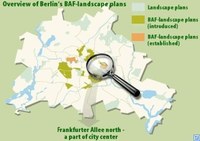
Use of regulations has proven to be an effective mean of increasing green cover in the Berlin city centre as every new development needs to comply with BAF targets. The flexibility of the approach provides significant advantages. Developers can choose between a number of different options for greening or creating permeable surfaces and pick those that are the most beneficial and effective for themselves and the users of the development. Collaboration between the Berlin departments of landscape planning and land use planning has ensured that the two planning instruments central to the implementation of the BAF are working in a coordinated way. Another factor that clearly contributes to its success is that the measures visibly contribute to the development of a better environment in the inner city. BAF is compulsory only in areas where legally binding Landscape Plans are present (16% of Berlin in 21 distinct areas). Outside these areas, the BAF is voluntary and can be used as a guideline for encouraging environmental measures to be incorporated when changes to the existing building structures are proposed. Due to its simplicity and the rising awareness of environmental issues, architects, builders and property owners tend to use the BAF, which is a sign of its success. However, the fact that BAF is voluntary outside areas covered by Landscape plans makes it difficult to speculate on its actual potential for implementation. The discussion with one of the local contact persons highlighted that in “some districts the nature conservation has a higher value than in others, and so some local administrators are more successful in convincing the builders to apply it. Sometimes builders themselves have interest to make their project “greener” and more sustainable. In some districts, builders need to gain the acceptance of the residents, and BAF can help. Thus, the realization of the BAF depends on many factors, mainly the active communication of the agencies in the districts and the environmental consciousness of the residents.
Os detalhes de implementação (custo, prazo, equipa, condições de sucesso) ainda não estão disponíveis para esta prática.
National / regional programmes
Vias de financiamento indicativas para práticas deste tipo — verifique sempre os avisos abertos e as regras de elegibilidade de cada programa.
Implementa esta prática? Reivindique-a — implementadores verificados obtêm um contacto público na página e podem propor correções.
De onde foi obtida a informação desta prática, e quando.
Mauritânia
Criado para compensar a interrupção do caudal causada pelas barragens de Diama e Manantali, o sistema de diques e comportas …
Guiné-Bissau
A UNESCO classificou o arquipélago de 88 ilhas dos Bijagós como Reserva da Biosfera em 1996 e, em julho de …
Peru
Em abril de 2024, o Peru concedeu a sua 1ª Concessão de Conservação sobre um oásis de nevoeiro: 6.449 ha …
Iémen
Desde 1997, o apoio do PNUD/UNOPS financiado pelo GEF ajudou o arquipélago iemenita de Socotra a definir 426 km2 de …
Abrir o copiloto completo Baseado em práticas citadas — verifique sempre as fontes.