Proteger o Território Contra Espécies Invasoras — Controlo Liderado por Guardas Indígenas (Norte da Austrália)
Austrália
O Programa de Guardas Indígenas da Austrália financia mais de 40 grupos de guardas no norte do país para controlar …
Noruega · Tana · Ver o perfil de Noruega
Evidência: Observacional / pré-pós Top 89% 27/100 · Pergunte a Evidence Copilot sobre esta prática
A Agência do Ambiente da Noruega financia armadilhas em 53 dos 63 rios afetados — uma delas em Seida, no rio Tana, capturou 7.666 salmões-rosa invasores em 2023 — para proteger o salmão-do-atlântico, hoje também em risco de extinção, de uma invasão bienal crescente.
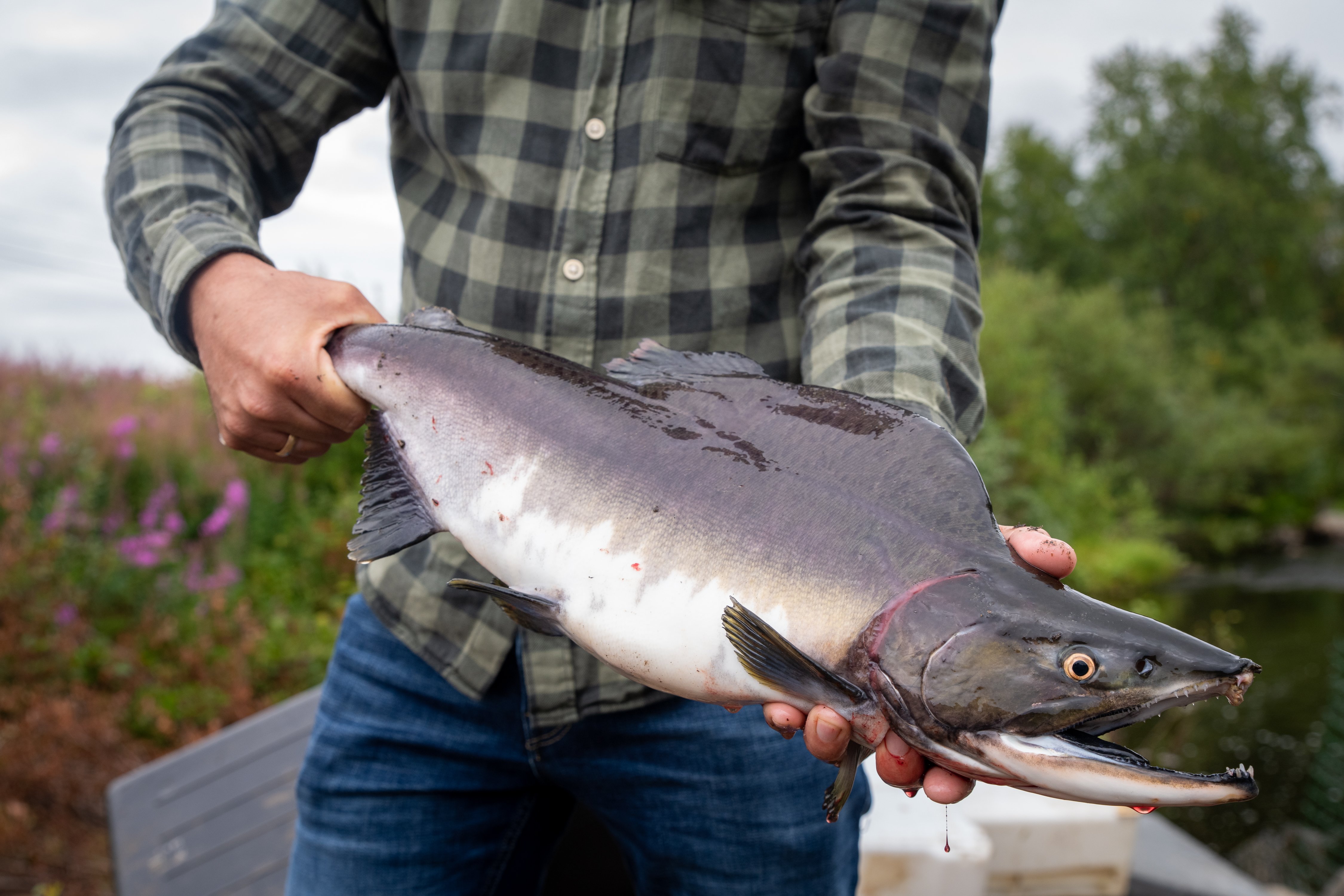
NO07Pink salmon (Oncorhynchus gorbuscha), originally introduced to Russia's Kola Peninsula in the mid-20th century, now invade Norwegian rivers biennially, arriving in odd years (2021, 2023, 2025) with further recurrence expected in 2027. Norway's Environment Agency (Miljodirektoratet) describes native Atlantic salmon as 'at risk of extinction', with only approximately 323,000 wild spawners counted nationally in 2024. The Tana River, managed jointly with cross-border partners including Statsforvalteren i Troms og Finnmark, is one of the country's most significant salmon rivers.
To trap and remove invasive pink salmon before they can spawn and compete with native Atlantic salmon, while releasing incidentally-caught Atlantic salmon alive, in the context of a nationally expanding, state-funded control programme.
Miljodirektoratet, the Norwegian Veterinary Institute (Veterinaerinstituttet) and Statsforvalteren i Troms og Finnmark operate fish traps on Norwegian rivers during biennial pink salmon runs. The flagship installation is a 400-metre pole-row trap at Seida on the Tana River, run by the Veterinary Institute. By 2025, state-funded control measures were in place on 63 rivers nationally, with 53 fitted with fish traps. Trapped pink salmon are euthanised; incidentally caught Atlantic salmon are released alive.
In 2023, 481,463 pink salmon were caught or observed nationally, including 7,666 at the Seida trap on the Tana River; officials nonetheless described the Tana trap as 'a pilot rather than a solution' since 'considerable quantities' of fish passed through unblocked that year. By mid-summer 2025, roughly 150,000 fish had been caught nationally, approximately 30,000 of them from the Tana River alone. On a single documented day, 47 incidentally-caught Atlantic salmon were released alive. A peer-reviewed ecosystem study on the Skallelv river found that white-tailed eagle sightings rose from a mean of 0.38 to 10.9 per day during the 2021-2022 pink salmon invasion, as carcasses became available as a food source.
Catch totals have grown across successive biennial cycles despite expanded trapping infrastructure, though available sources do not clarify whether this reflects rising invasion pressure, improved trapping efficiency, or both. The programme is transparently scaled and reported annually, but suppression efficacy at flagship sites like Tana remains unconfirmed by officials' own account.
National / regional programmes
Vias de financiamento indicativas para práticas deste tipo — verifique sempre os avisos abertos e as regras de elegibilidade de cada programa.
Implementa esta prática? Reivindique-a — implementadores verificados obtêm um contacto público na página e podem propor correções.
De onde foi obtida a informação desta prática, e quando.
Austrália
O Programa de Guardas Indígenas da Austrália financia mais de 40 grupos de guardas no norte do país para controlar …
Roménia
O projeto LIFE GreenDanube, financiado pela UE (2006-2010), removeu 12,2 hectares da espécie invasora Amorpha fruticosa e acrescentou 953,5 hectares …
Países Baixos
Desde 1941, os conselhos regionais de águas dos Países Baixos gerem um programa nacional de controlo de ratos-almiscarados e coipos …
Portugal
Programa LIFE da UE (2019–2025, LIFE18 NAT/PT/000927) removeu gatos assilvestrados e plantas invasoras das ilhas-barreira da Ria Formosa; os ninhos …
Abrir o copiloto completo Baseado em práticas citadas — verifique sempre as fontes.