Yokosuka City's ChatGPT Trial — Japan's First Municipal Rollout for Administrative Work
Japan
In April 2023, Yokosuka became Japan's first city to open ChatGPT to all ~4,000 municipal employees for daily admin work. …
Germany · Berlin · See the Germany profile · See the Berlin profile
Evidence: Observational / pre–post Top 12% 80/100 · Ask Evidence Copilot about this practice
Germany's federal digital ministry (BMDS) piloted agentic AI across 19 municipalities with 9 AI startups: GDPR-request processing cut over 90%, care-application processing cut 45%, and 600 administrative processes modeled in 12 weeks, with 95% municipal satisfaction.
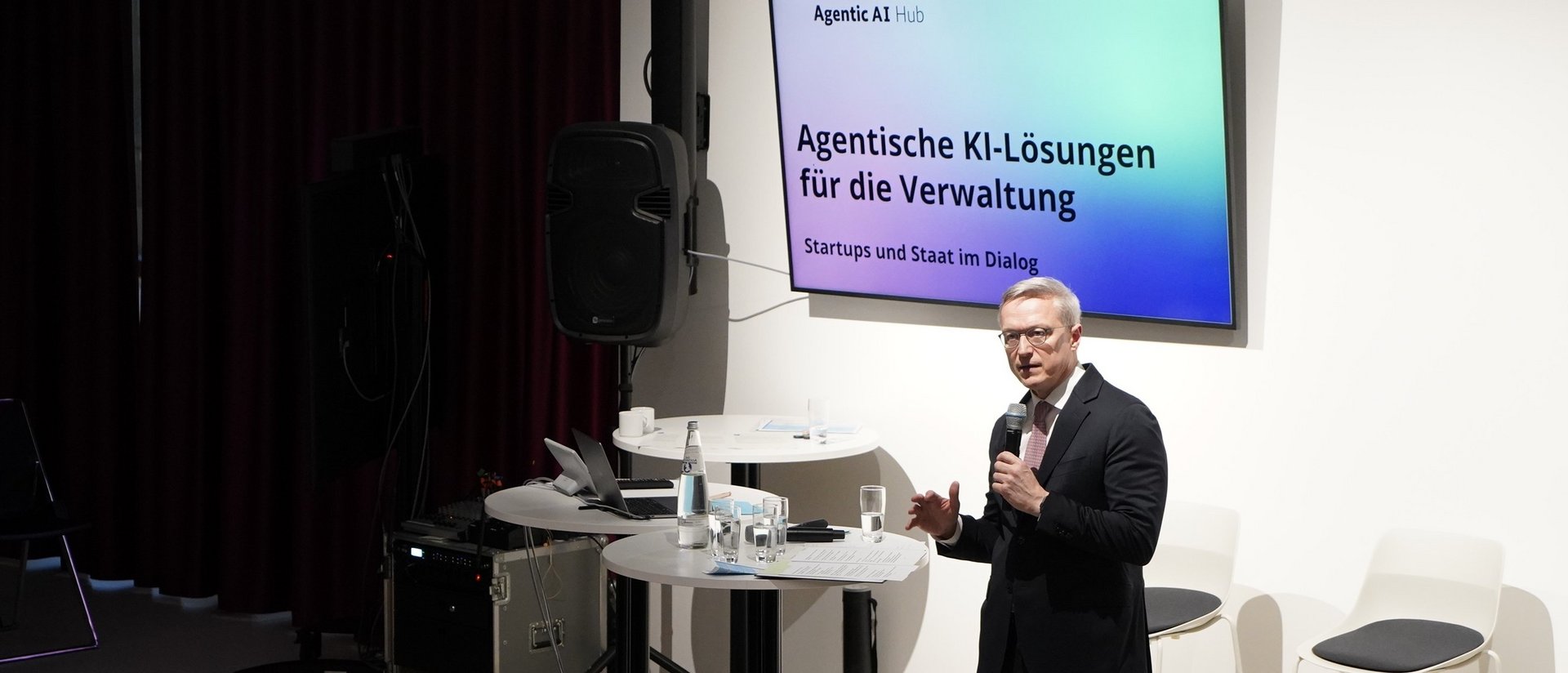
Between March and May 2026, Germany's Federal Ministry for Digital Affairs and State Modernisation (BMDS) ran a three-month 'Agentic AI Hub' pilot pairing 19 municipalities with 9 AI startups across 20 pilot projects, selected from nearly 600 initial submissions.
To test agentic AI tools on real municipal administrative processes, including GDPR information requests, care-assistance applications, meeting-protocol drafting, and process modelling.
20 pilot projects tested agentic AI on specific administrative workflows; separately, seven municipalities used AI tools to model roughly 600 administrative processes over 12 weeks, work that conventionally takes three or more weeks per process.
GDPR information-request processing time fell by more than 90% (saving about 28 hours per case); 'Hilfe zur Pflege' care-assistance application processing fell 45% overall (active processing time down 31%); meeting-protocol drafting cut manual post-processing from 45 to 10 minutes (78% reduction); AI-assisted pre-screening of care applications cost around €1 per request; Flensburg alone produced 264 process models. By pilot end, 70% of tested solutions were in operational use, 65% had been implemented within four weeks, 80% were processing real municipal data, municipalities reported 95% satisfaction, and staff in 15 of 18 cases said they felt 'secure' using the tools.
BMDS assessed that roughly half of the tested solutions could transfer to other municipalities and most pilots had already started follow-on projects, but a full evaluation report and a planned 2027 dynamic procurement system to scale nationally were still pending at the pilot's conclusion.
Implementation detail (cost, timeline, staffing, conditions for success) is not yet available for this practice.
National / regional programmes Digital Europe Programme Recovery and Resilience Facility (national plans)
Indicative funding routes for practices of this type — always check each programme's current calls and eligibility rules.
Do you run this practice? Claim it — verified implementers get a public contact pathway and can propose corrections.
Where this practice's information was retrieved from, and when.
Japan
In April 2023, Yokosuka became Japan's first city to open ChatGPT to all ~4,000 municipal employees for daily admin work. …
Tajikistan
At Dushanbe's AI CONF, Tajikistan's Ministry of Industry agreed with Perplexity AI and Epsilon3.ai to pilot Comet, billed as the …
United Arab Emirates
At a May 2026 national retreat, the UAE federal government launched its first four 'agentic AI' systems — for procurement, …
Germany
Baden-Württemberg built F13, the first AI assistant in productive use across a full German state administration, running on sovereign infrastructure; …
Open full copilot Grounded in cited practices — always check the sources.