National AI Campaign — Mongolia's Nationwide AI Teacher-Training Drive Across All 21 Provinces
Mongolia
AI Academy Asia's five-year National AI Campaign, backed by UNICEF Mongolia, M Bank and Golomt Bank, has trained 1,000 teachers …
Taiwan · Tainan · See the Taiwan profile
Evidence: Quasi-experimental Top 24% 60/100 · Ask Evidence Copilot about this practice
A quasi-experimental study (n=109, grade 5) in Tainan found girls entered an AI course scoring lower on AI literacy than boys, but a STEAM-PBL-AIoT literacy curriculum closed the gap by post-test, with girls in that group outperforming boys in the comparison course.
UNESCO estimates around 70 countries have adopted national AI strategies naming AI literacy as a citizenship skill; researchers at National Cheng Kung University (Tainan) and the University of Georgia found gender gaps in AI literacy can already be measured among ten- and eleven-year-olds before any formal AI instruction.
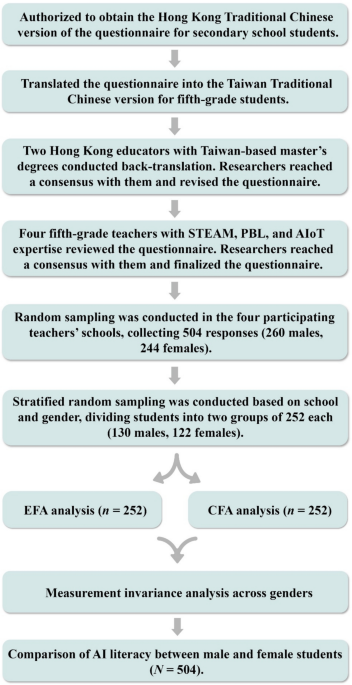
The team first validated a four-part AI literacy questionnaire (affective, behavioural, cognitive, ethical) with 504 Taiwanese fifth-graders. A second, quasi-experimental study then compared two elective AI courses in the second semester of fifth grade at a school in southern Taiwan: a comparison group (n=55) taking a real-world AIoT-applications course, and an experimental group (n=54) following a STEAM-project-based-learning-AIoT AI literacy curriculum.
Both groups improved from pre- to post-test, but the AI literacy course produced larger overall gains. Female students entered both courses scoring lower than male students; by post-test the gender gap had closed in the AI literacy group, and female students in that group outperformed male students in the AIoT-only comparison course. Ethical-reasoning gains were similar across both groups.
The authors caution this is a single-school pilot (109 students across two sections) rather than a multi-site trial, and call for replication before drawing conclusions about scalability.
Do you run this practice? Claim it — verified implementers get a public contact pathway and can propose corrections.
Where this practice's information was retrieved from, and when.
Mongolia
AI Academy Asia's five-year National AI Campaign, backed by UNICEF Mongolia, M Bank and Golomt Bank, has trained 1,000 teachers …
United Kingdom
The UK Department for Education committed £8.2 million to the Advanced Maths Support Programme to raise girls' participation in advanced …
Honduras
UNICEF's Tinkering with Tech and AI pilot brings Micro:bit-based STEM and AI learning to 100+ school centres in northern Honduras, …
Nigeria
Tech4Dev's free 12-month fellowship trains African women and girls (16–40) in Data Science & AI Engineering plus 6 other tracks. …
Open full copilot Grounded in cited practices — always check the sources.