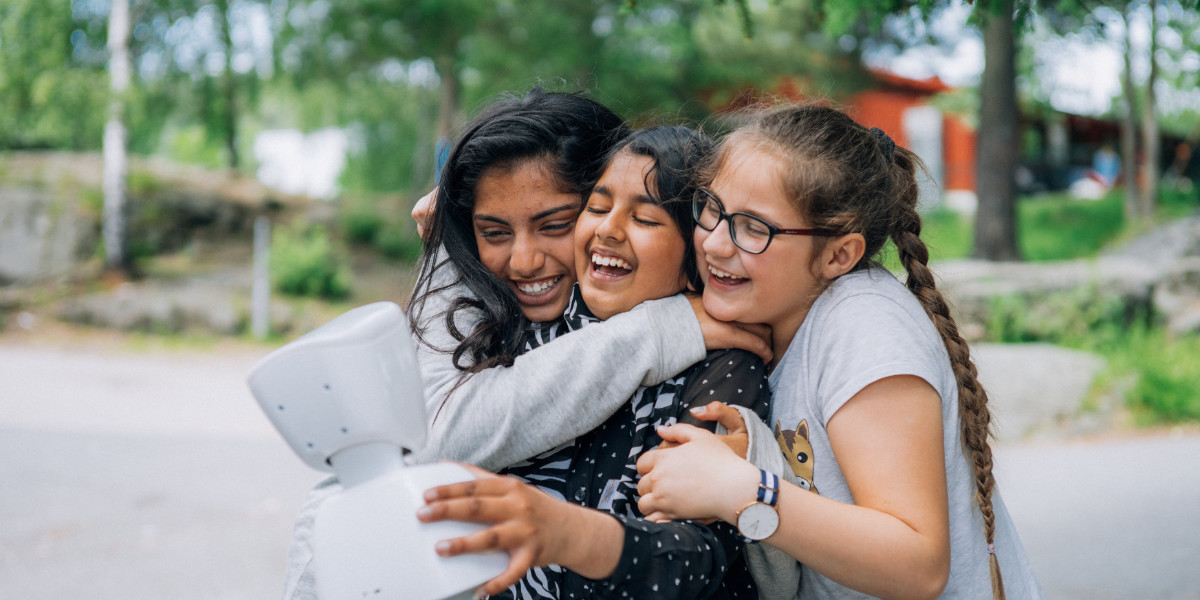
Norway's No Isolation makes the AV1 telepresence robot, letting children with cancer and other long-term illnesses attend class remotely as their 'eyes, ears and voice.' A UK-government-funded evaluation found average school attendance rose from 29% to 58% among recipients.
522,124 GBP
UK evaluation grant (2018–2020)
29 %
Average school attendance before AV1 (interim) (interim, 2018–2020 evaluation)
58 %
Average school attendance after AV1 (interim) (interim, 2018–2020 evaluation)
21 robots
AV1 robots freely available in the Netherlands (n/a)
3,000+ units across 17 European countries
AV1 units deployed globally (n/a)
10,000+ children in 2,500+ schools
Children reached globally (n/a)
Details
Maturity
Established
Promoter
No Isolation
Period
2015–present (UK evaluation 2018–2020)
Keywords
assistive technology, robotics, inclusive education, chronic illness support
Context
Children undergoing long-term treatment for cancer or other serious illnesses often disappear from school for months at a time, losing both academic ground and daily contact with classmates and teachers — a well-documented risk factor for social isolation and delayed reintegration. Norwegian company No Isolation builds AV1, a small telepresence robot that sits in the child's usual seat in class, letting them see, hear and speak to the lesson remotely via tablet or phone.
Activities
In 2018 the UK Department for Education awarded £522,124 to the Hospital and Outreach Education network for a two-year, government-funded evaluation of telepresence robots' impact on attainment, reintegration and wellbeing, completed in 2020. In the Netherlands, the Vodafone Netherlands Foundation and Stichting Kind en Ziekenhuis have made 21 robots freely available.
Results
Interim data from AV1 recipients, including children with cancer, showed average school attendance rising from 29% to 58%. Research on the more than 25 children who used the Dutch-funded robots found nearly all reported feeling less lonely and happier being able to see their class and teacher again. Globally, No Isolation reports over 3,000 AV1 units deployed across 17 European countries, reaching more than 10,000 children in over 2,500 schools.
Conclusions
The strongest published evidence concerns attendance and psychosocial wellbeing rather than direct learning outcomes, and case studies describe individual teachers improvising classroom routines around the robot rather than following a structured training programme — real strengths and real limits that should inform how the evidence is read.
Implementation
Indicative cost
Medium (€50k–€500k) — UK government evaluation grant of £522,124 (2018–2020); device and connectivity costs beyond that grant are not published in available sources.
Time to results
Long (> 3 years) — Deployed since 2015; UK Department for Education evaluation ran 2018–2020; global deployment (3,000+ units, 17 countries) has continued to scale since.
Staffing & skills
No Isolation (manufacturer), UK Hospital and Outreach Education network, Classroom teachers at host schools, Vodafone Netherlands Foundation and Stichting Kind en Ziekenhuis (Netherlands)
Conditions for success
A classroom teacher willing to integrate and manage the robot's presence (e.g. its 'raised hand' light)
Funding or donation of the device itself, since families and schools are not typically expected to buy it outright.
A funded evaluation or monitoring mechanism to track attendance and wellbeing outcomes.
Common failure modes
Reliance on individual teachers improvising classroom routines around the robot rather than following a structured, replicable training programme.
Commonly funded by
National / regional programmesPhilanthropic / foundation funding
Indicative funding routes for practices of this type — always check each programme's current calls and eligibility rules.
Do you run this practice?
Claim it —
verified implementers get a public contact pathway and can propose corrections.
Data sources
Where this practice's information was retrieved from, and when.
A €4m Friuli Venezia Giulia project deploys AI speech-to-text captioning for deaf/hard-of-hearing students. A 2025 peer-reviewed SWOT/TOWS analysis of stakeholders …
An EdUHK three-arm RCT found a NAO robot delivering 12 weekly social-skills sessions produced significantly greater communication and social-interaction gains …