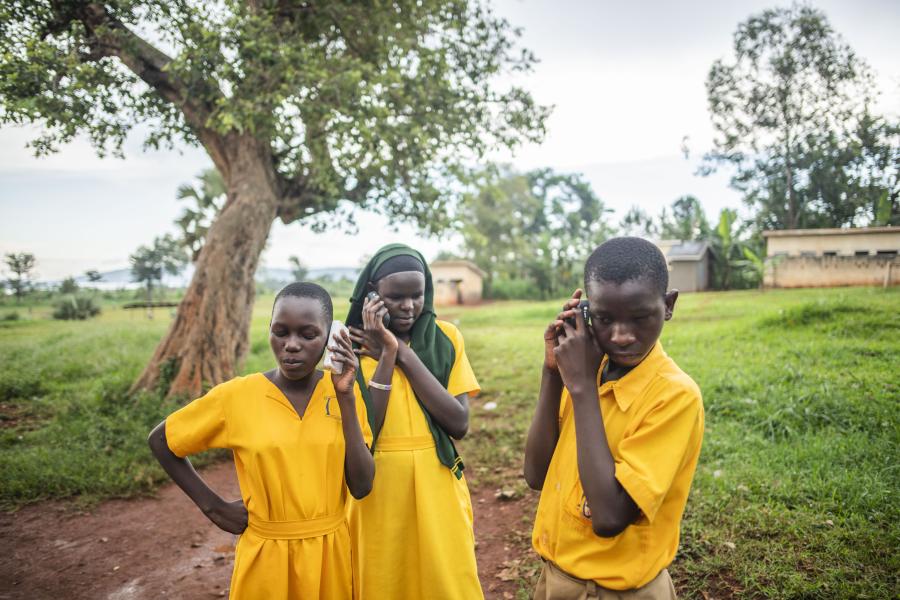
Since 2017, UNICEF and Uganda's Ministry of Education have converted primary textbooks into audio, large-print and sign-language formats for blind, low-vision and deaf learners in 20 model schools, part of a global UNICEF initiative that added an AI production pipeline in 2024.
Of which earned by visually impaired students (2021)
2.5 million
Estimated children with disabilities nationally
250000 children
Children with disabilities accessing education nationally (fewer than)
Details
Maturity
Pilot
Promoter
UNICEF Uganda; Ministry of Education and Sports (MoES); Kyambogo University; National Curriculum Development Centre (NCDC); Norwegian Government; UNPRPD Fund
Period
2017–ongoing (global initiative added AI-assisted production in 2024)
Keywords
accessibility, inclusive education, assistive technology, disability, curriculum development
Context
Since 2017, UNICEF Uganda and the Ministry of Education and Sports have worked to make classroom learning accessible to children who are blind, have low vision, or are deaf, with funding from the Norwegian Government and the UN Partnership on the Rights of Persons with Disabilities (UNPRPD) Fund, and curriculum-development support from Kyambogo University and Uganda's National Curriculum Development Centre.
Objectives
The programme set out to adapt Primary 4 and Primary 6 textbooks in Mathematics, English and Science into audio, large-print and sign-language formats, and to equip learners and classrooms with the assistive devices needed to use them.
Activities
The work is concentrated in 20 model and inclusive schools, including St. Bernadette's Model Primary School in Hoima and Spire Road Primary School in Jinja. Assistive devices distributed include Victor Readers, Orbit Braille Readers, Blaze ET devices, text-to-speech-equipped laptops and projectors for sign-language interpretation, alongside Teachers' Guides developed and piloted in the same schools. Uganda is one of roughly ten to eleven countries in UNICEF's global Accessible Digital Textbooks initiative, which in 2024 began adding an AI-automated production pipeline, though independent confirmation that this pipeline has specifically been used for Uganda's textbooks was not found.
Results
Reported outcomes remain modest and mostly anecdotal: in 2021, Spire Road Primary recorded four first-grade passes on the Primary Leaving Examination, two of them earned by visually impaired students, alongside reports of reduced absenteeism and improved student confidence.
Conclusions
At roughly 20 of Uganda's many thousands of primary schools, against an estimated 2.5 million children with disabilities nationally of whom fewer than 250,000 currently access education, the programme's reach remains a small fraction of national need, and no systematic outcome evaluation has been published.
Implementation
Indicative cost
Medium (€50k–€500k) — Multi-donor funded (Norwegian Government, UNPRPD Fund) covering textbook conversion into audio/large-print/sign-language formats plus assistive devices across 20 schools.
Time to results
Long (> 3 years) — Running since 2017; the global Accessible Digital Textbooks initiative it is part of added an AI-assisted production pipeline in 2024.
Staffing & skills
UNICEF Uganda, Ministry of Education and Sports (MoES), Kyambogo University, National Curriculum Development Centre (NCDC), Classroom teachers (Teachers' Guides piloted in 20 schools)
Conditions for success
Multi-donor funding (Norwegian Government, UNPRPD Fund) sustained over multiple years
Curriculum-development partnership with universities and the national curriculum body
STMicroelectronics Foundation, ITU and a blind Milan professor run train-the-trainer digital-literacy classes for blind and visually-impaired adults in Dakar. An …
A €4m Friuli Venezia Giulia project deploys AI speech-to-text captioning for deaf/hard-of-hearing students. A 2025 peer-reviewed SWOT/TOWS analysis of stakeholders …