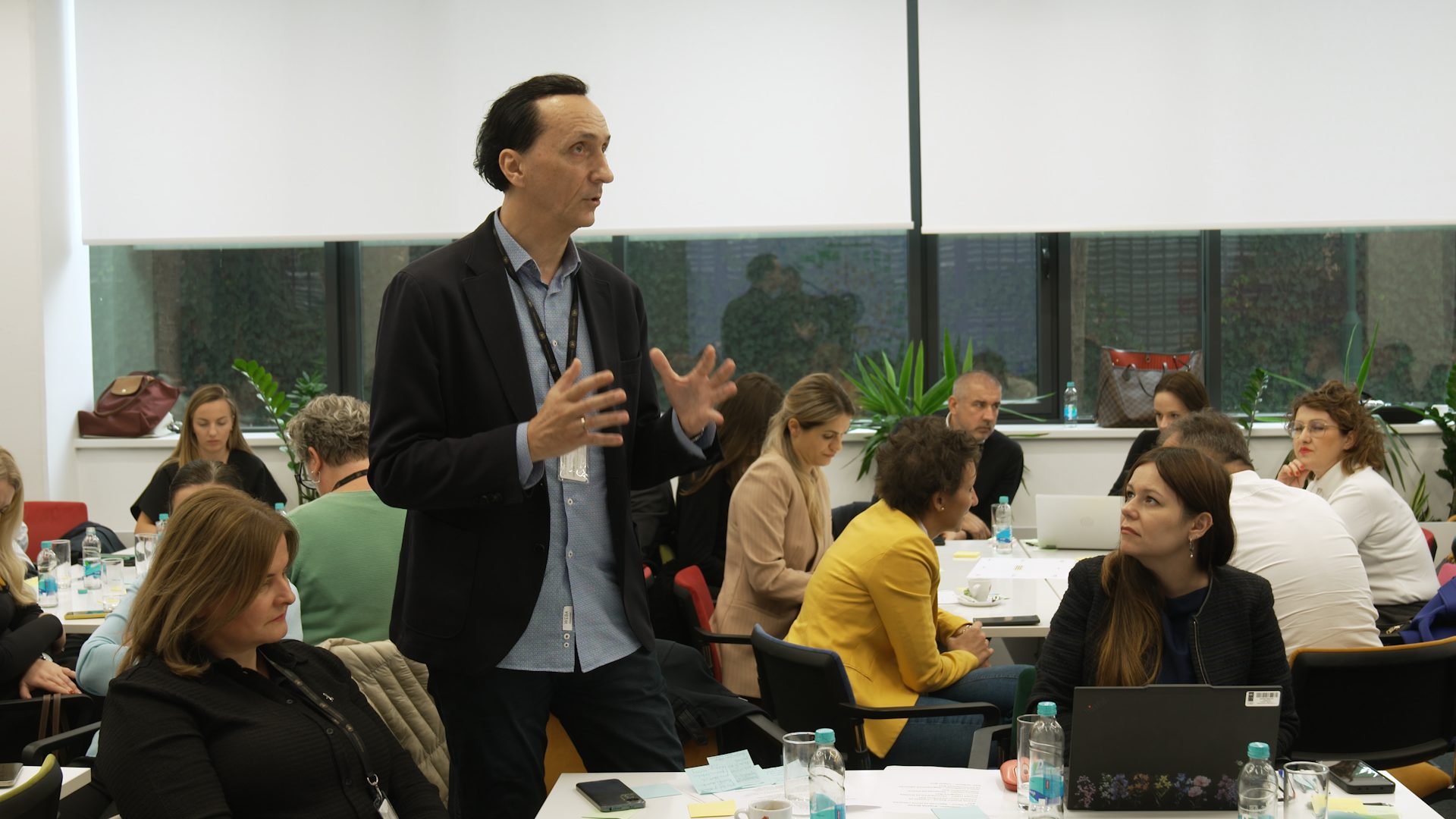
A UNDP survey of 516 civil servants across 57 Bosnian state institutions found 69% already use AI tools like ChatGPT with no policy oversight, and 95% had never been trained — prompting a licensed, governed AI rollout by the Ministry of Communications and Transport.
516
Civil servants surveyed (2025)
57
Institutions surveyed (2025)
69 %
Already using AI tools at work
95 %
Never received AI training
96 %
Want AI training
Details
Maturity
Pilot
Promoter
Ministry of Communications and Transport of Bosnia and Herzegovina, with UNDP Bosnia and Herzegovina
Period
2025-2026
Keywords
public administration, AI governance, civil service training, shadow AI, digital transformation
Context
In 2025 the United Nations Development Programme (UNDP) surveyed 516 civil servants across 57 state-level institutions in Bosnia and Herzegovina about their use of generative AI at work, with results announced by Minister of Communications and Transport Edin Forto in September 2025.
Objectives
Assess the extent of unsanctioned 'shadow AI' use and civil servants' training needs to inform a governed AI rollout.
Activities
The Ministry of Communications and Transport is now working with UNDP to license Microsoft's AI tools within a government-controlled environment and roll out structured training.
Results
The survey found 69% of respondents already used AI tools — mostly free consumer services like ChatGPT — entirely outside any government policy, licensing or security framework, and that 95% had never received formal training even though 96% said they wanted it.
Conclusions
Independent outlet Detektor warned that untrained staff feeding sensitive citizen and institutional data into foreign-hosted consumer AI tools created a real data-protection risk, given Bosnia and Herzegovina still has no national AI law or state-level AI strategy; as of the announcement, the governed rollout remained an early-stage commitment with no licensing, training-completion or productivity figures yet published.
Implementation
Indicative cost
Medium (€50k–€500k)
Time to results
Medium (1–3 years)
Staffing & skills
Ministry of Communications and Transport of Bosnia and Herzegovina, UNDP Bosnia and Herzegovina
Conditions for success
Licensing enterprise AI tools (Microsoft) within a government-controlled environment
Structured, government-wide training programme
Other state institutions adopting the same model
Common failure modes
Widespread ungoverned 'shadow AI' use already creates a real data-protection risk
Bosnia and Herzegovina has no national AI law or state-level AI strategy yet
Commonly funded by
National / regional programmes
Indicative funding routes for practices of this type — always check each programme's current calls and eligibility rules.
Do you run this practice?
Claim it —
verified implementers get a public contact pathway and can propose corrections.
Data sources
Where this practice's information was retrieved from, and when.
Ecuador's Superintendencia de Competencia Económica adopted the country's first public-sector AI ethics code in 2025, aligned with UNESCO's AI Recommendation, …