Basic Education Strengthening Project (BESP) – Tech-Enabled Teaching & Youth Clubs
Lesotho
A $7.1M World Bank/GPE-financed project gave Lesotho teachers tech-enabled training and ran youth clubs in junior secondary schools, reaching 40,569 …
Sudan · Kosti · See the Sudan profile
Since 2014, War Child Holland, UNICEF and Ahfad University have run tablet-based learning games for out-of-school children in three Sudanese states. A peer-reviewed evaluation found much larger numeracy and literacy gains than the government's alternative programme.
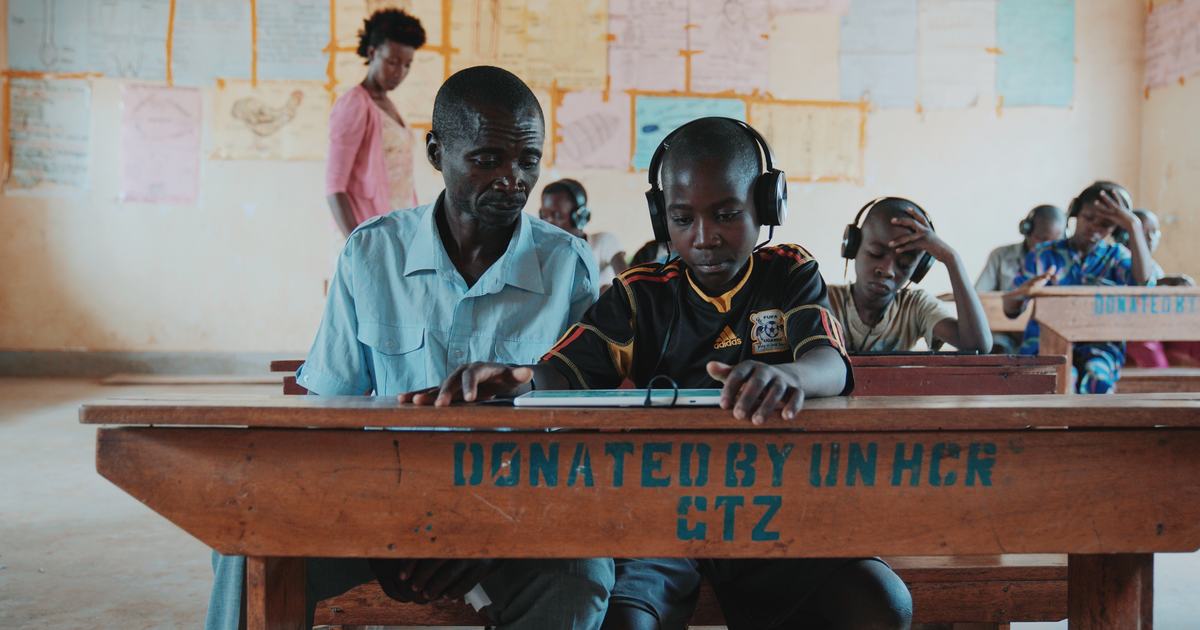
Can't Wait to Learn (run locally as e-Learning Sudan) is a self-directed, tablet-based digital game teaching numeracy and literacy to children who have never attended school. Launched in 2014 by UNICEF Sudan, War Child Holland, Ahfad University for Women and Sudan's Ministry of Education, it lets a single facilitator support learners at very different levels without formal teacher training — a design suited to conflict-affected, resource-poor settings.
The programme aims to give out-of-school children in Sudan foundational numeracy, literacy and psychological wellbeing gains through self-paced digital learning games, in states with limited access to formal schooling.
An independent quasi-experimental, mixed-methods evaluation conducted between December 2017 and December 2018 compared 221 children aged 7-9 in White Nile, North Kordofan and Al Qadarif states who used Can't Wait to Learn against children in the government's Alternative Learning Programme. Children using the digital programme improved their maths scores by nearly twice as much and their reading scores by almost 2.7 times as much as the comparison group, alongside gains in psychological wellbeing, corroborated by 33 focus groups and key-informant interviews.
The model has since been adapted by War Child for other crisis-affected countries and UNICEF/War Child Holland set targets of reaching 35,000 out-of-school children in Kassala State and at least 6,000 hard-to-reach children more broadly, though Sudan's civil war since 2023 has disrupted the education system and strained the pace of planned scale-up, so reach figures should be read as cumulative and regional rather than a current national total.
Implementation detail (cost, timeline, staffing, conditions for success) is not yet available for this practice.
Where this practice's information was retrieved from, and when.
Lesotho
A $7.1M World Bank/GPE-financed project gave Lesotho teachers tech-enabled training and ran youth clubs in junior secondary schools, reaching 40,569 …
Tanzania
Tanzania's official eLearning partner providing curriculum-aligned digital content to 3M+ secondary school students in all 25 regions, with an offline …
Yemen
IRC's 'Safe Space to Learn' curriculum trained 50 displaced women in Yemen's Khanfar district over 20 weeks with loaned smartphones; …
Cambodia
Cambodia's MoEYS, Meta, and KAPE localised Meta's WeThinkDigital curriculum in Khmer for secondary schools. Piloted 2022–2023 in 6 New Generation …
Open full copilot Grounded in cited practices — always check the sources.