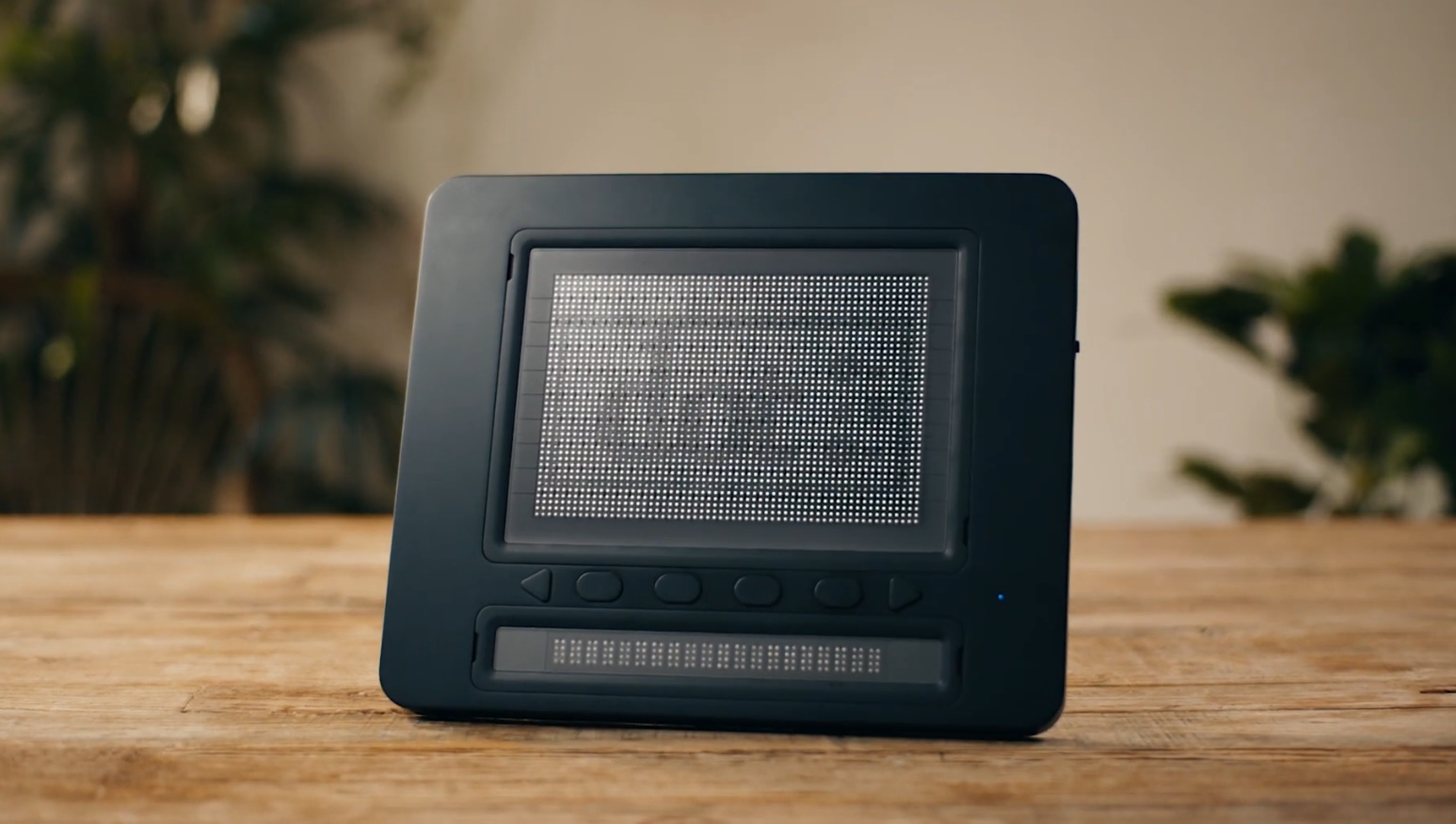
Seoul-based Dot Incorporation built the first commercialised electromagnetic tactile display, letting blind and low-vision users feel braille text and graphics refreshed in real time from any connected phone or computer. Deployed in public kiosks and integrated with Apple's acces
Dot Incorporation was founded in Seoul in 2015 by Eric Ju Yoon Kim and Ki Kwang Sung after identifying the high cost and bulk of conventional piezoelectric braille displays as a barrier to digital access for blind and low-vision people. Its core innovation is an electromagnetic pin-actuation mechanism, adapted from speaker technology, that Dot states is roughly ten times smaller, lighter and cheaper to produce than legacy piezoelectric actuators.
Activities
The flagship Dot Pad device, demonstrated as a pre-production prototype in March 2022, uses a 2,400-pin grid to render braille text and tactile graphics — such as charts, maps and diagrams — refreshed in roughly one second, connected wirelessly to a smartphone or computer. Dot has secured a formal partnership with Apple to support a tactile-graphics API introduced in iOS 15.2, giving Dot Pad users direct access to VoiceOver-compatible content on iPhone and iPad, and has also partnered with the American Printing House for the Blind and HumanWare on a related Dynamic Tactile Device initiative.
Results
Dot Pad won Best of Innovation in the Accessibility category at CES 2023. By November 2022 the company had raised roughly 25 billion Korean won (about US$19 million) through a Series B round while holding 130 patents. Beyond individual devices, Dot Pad units have been installed as permanent public-access kiosks in Busan, South Korea, and the company reports institutional orders worth millions of dollars from public and private buyers worldwide.
Conclusions
The evidence base for Dot Pad is weaker than its commercial and design traction: no published clinical or educational evaluation of its impact on braille literacy or task performance was found at the time of writing, so it is scored here as a promising but not yet rigorously evaluated practice.
Implementation
Indicative cost
High (€500k–€5M) — No public unit pricing found; scored high given it is specialised, patented hardware (130 patents) from a venture-funded company (~US$19M Series B), even though ~10x cheaper than legacy piezoelectric displays per Dot's own claim.
Time to results
Long (> 3 years) — Company founded 2015; flagship Dot Pad reached pre-production prototype stage in March 2022 and CES recognition in 2023 — a long, multi-year R&D-to-commercialisation timeline.
Staffing & skills
Dot Incorporation R&D/engineering team (founders Eric Ju Yoon Kim and Ki Kwang Sung), Apple accessibility engineering (API integration), Partner organisations: American Printing House for the Blind, HumanWare
Conditions for success
Proprietary electromagnetic pin-actuation technology cheaper and smaller than legacy piezoelectric displays
Platform partnership with Apple's VoiceOver/tactile-graphics API for OS-level integration
Public kiosk placement extends reach beyond individual purchasers
Common failure modes
No independent peer-reviewed usability or learning-outcome evaluation to date, so effectiveness for braille literacy or task performance is unverified
Commonly funded by
Own resources / municipal budget
Indicative funding routes for practices of this type — always check each programme's current calls and eligibility rules.
Do you run this practice?
Claim it —
verified implementers get a public contact pathway and can propose corrections.
Data sources
Where this practice's information was retrieved from, and when.
Bengaluru-based Thinkerbell Labs built Annie, an audio-guided, self-correcting braille teaching device that lets blind and low-vision students learn independently. Deployed …
A free government app gives Bahamians with disabilities one-touch access to emergency alerts, sign-language interpretation, job listings and transport bookings. …