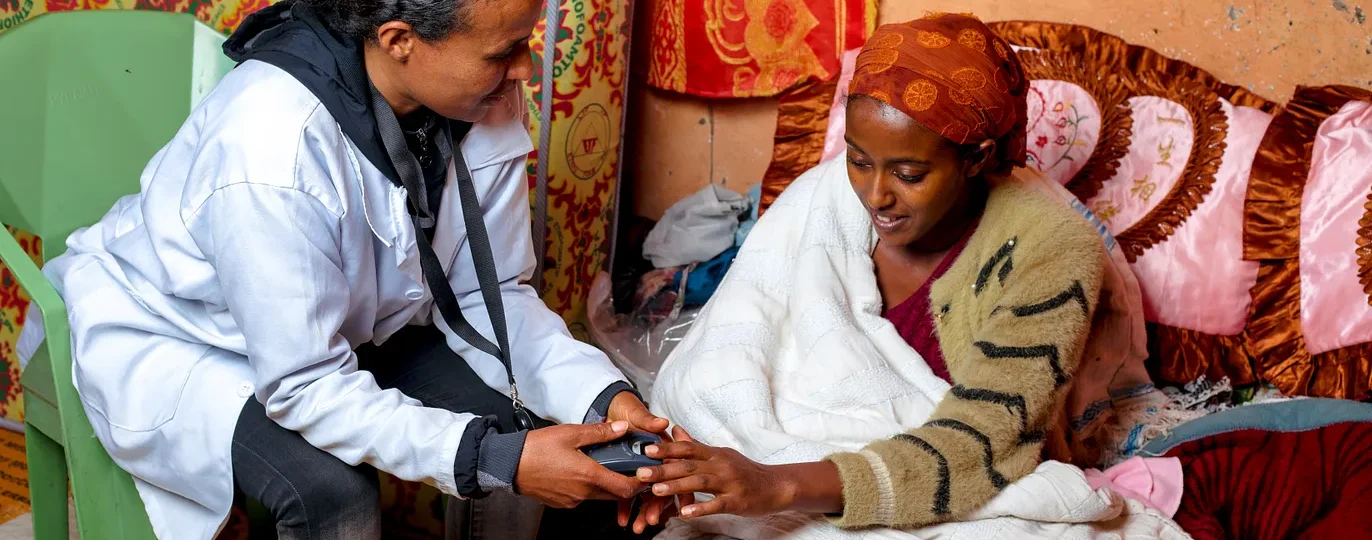
Simprints and JSI built fingerprint ID into Ethiopia's community health data system, letting Health Extension Workers serving low-literacy populations without formal ID pull up patient records without names or paperwork, in a decade-long partnership.
39 %
Data-quality audit discrepancy rate before biometric ID (one woreda) (pre-implementation)
<5 %
Data-quality audit discrepancy rate after biometric ID (one woreda) (post-implementation)
2.7 x faster
Biometric fingerprint search speed vs digital-ID lookup (2023)
8 x faster
Biometric fingerprint search speed vs manual name search (2023)
Details
Maturity
Established
Promoter
Simprints & JSI (John Snow, Inc.), with Ethiopia's Ministry of Health
Period
2014–2024
Keywords
healthcare, biometric identification, community health, maternal & child health, digital identity
Context
Many rural Ethiopian patients lack formal identity documents and cannot always be reliably identified by name alone, which made it hard for Health Extension Workers to retrieve accurate records during home and clinic visits. Simprints, a UK-based non-profit specialising in offline biometric identification for low-resource settings, partnered with JSI (John Snow, Inc.) and Ethiopia's Ministry of Health to address this gap within the national Electronic Community Health Information System (eCHIS).
Activities
Health Extension Workers were equipped with a pocket fingerprint scanner linked to a smartphone app, letting them retrieve a patient's record by fingerprint instead of a paper-based name search. The system supports services ranging from family planning to child health monitoring in remote and underserved areas, and the partnership has run for roughly a decade as of 2024.
Results
Simprints' 2023 impact review, covering its Ethiopia, Ghana, Bangladesh and Uganda health projects, found biometric fingerprint search 2.7 times faster than digital-ID lookup and 8 times faster than manual name search in Ethiopia. In the woreda studied, routine data-quality audit discrepancies fell from 39% to under 5%.
Conclusions
These figures come from Simprints' own monitoring and impact studies rather than a fully independent third-party evaluation, and no comparable discrepancy data were located for other deployment sites, so the improvement should be read as organisation-reported evidence from one district rather than a nationally representative result.
Implementation
Indicative cost
Medium (€50k–€500k) — NGO-supplied fingerprint scanners and app licensing integrated into government eCHIS infrastructure across multiple countries (Ethiopia, Ghana, Bangladesh, Uganda), sustained via a decade-long partnership rather than a single grant.
Time to results
Long (> 3 years) — Partnership described as running roughly a decade (to 2024), embedded in the national eCHIS system rather than a short pilot.
Staffing & skills
Health Extension Workers equipped with pocket fingerprint scanners and a linked smartphone app, Simprints (technical/NGO partner) and JSI (John Snow, Inc.) providing implementation support, Ethiopia's Ministry of Health as the national health-system owner
Conditions for success
Integration into the existing national eCHIS platform rather than a standalone system
Offline-capable biometric hardware suited to low-connectivity rural settings
Sustained decade-long partnership between an NGO technical partner and government health system
Where it fits
Governance type
NGO-government partnership within national health system
Scale
national (community health system)
Income level
low-income
Do you run this practice?
Claim it —
verified implementers get a public contact pathway and can propose corrections.
Data sources
Where this practice's information was retrieved from, and when.
Vietnam's KV-MAP platform (nkt.btxh.gov.vn) lets persons with disabilities register online or via app for disability certificates and support. Piloted in …