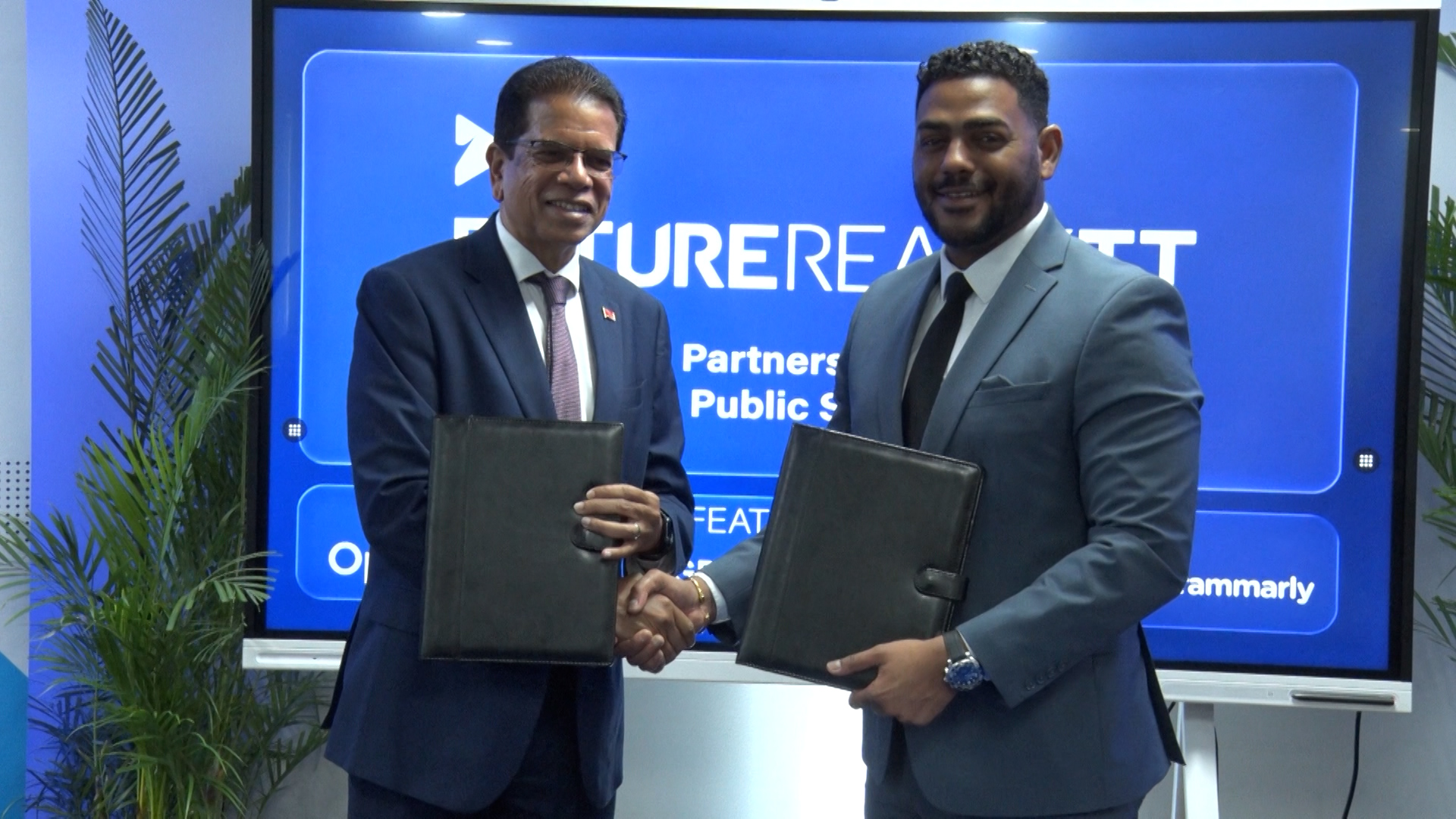
Trinidad and Tobago's MPAAI issued 550 ChatGPT/Grammarly Enterprise licenses to civil servants and reports a self-measured 75% productivity gain; it then joined OpenAI's Education for Countries cohort to scale the tool into schools nationwide.
550 licences
Enterprise AI licences issued to public officers (pilot) (2025–2026 pilot)
75 %
Self-reported productivity increase from pilot (pilot period)
Details
Maturity
Scaling
Promoter
Ministry of Public Administration and Artificial Intelligence (MPAAI), Trinidad and Tobago, with OpenAI
Period
2025–2026
Keywords
digital government, internal operations, generative AI, civil service training, public administration
Context
Trinidad and Tobago's Ministry of Public Administration and Artificial Intelligence (MPAAI) ran an internal pilot distributing 550 enterprise licences for ChatGPT and Grammarly to public officers. Building on that pilot, MPAAI and the Ministry of Education launched the FutureReadyTT programme on 28 May 2026, following Trinidad and Tobago's January 2026 entry into OpenAI's Education for Countries initiative alongside Estonia, Greece, Jordan, Kazakhstan, Slovakia and the United Arab Emirates.
Objectives
Extend ChatGPT-5 Enterprise, Grammarly Enterprise, ChatGPT EDU and Grammarly for Education across public administration and into schools, framed around three pillars: digital services, smart and efficient government services, and a fully digital nation — paired with staff upskilling and retraining rather than workforce replacement.
Activities
MPAAI distributed enterprise AI licences to public officers and is running a national AI-readiness assessment with UNDP and UNESCO, while the programme's education arm extends AI tools into schools.
Results
The ministry reported a self-measured 75% productivity increase from the pilot, but this figure and the 550-licence count come solely from ministry statements reported in local press, with no independent methodology, sample size or measurement period disclosed. Results from the UNDP/UNESCO AI-readiness assessment were not yet published.
Conclusions
FutureReadyTT is a resourced, actively expanding national AI-adoption programme, but its headline productivity claim remains an unverified, self-reported figure pending independent evaluation.
Implementation
Indicative cost
Medium (€50k–€500k) — 550 enterprise ChatGPT/Grammarly licences plus a national rollout of ChatGPT-5 Enterprise, Grammarly Enterprise, ChatGPT EDU and Grammarly for Education across public administration and schools; no public cost figures disclosed — conservative medium estimate pending curator review.
Time to results
Medium (1–3 years) — Pilot ran through 2025; formal FutureReadyTT programme launched 28 May 2026 and is actively scaling into schools — conservative medium-timeline estimate pending curator review.
Staffing & skills
Ministry of Public Administration and Artificial Intelligence (MPAAI), Ministry of Education, OpenAI (Education for Countries partnership)
Conditions for success
Enterprise licensing partnership with OpenAI as part of its Education for Countries cohort
Paired rollout with staff upskilling and retraining rather than workforce replacement
Parallel AI-readiness assessment with UNDP and UNESCO
Common failure modes
Headline productivity figure (75%) is self-reported by the ministry with no disclosed methodology, sample size or measurement period
Where it fits
Governance type
national government ministry
Scale
national (public administration and schools)
Commonly funded by
National / regional programmes
Indicative funding routes for practices of this type — always check each programme's current calls and eligibility rules.
Do you run this practice?
Claim it —
verified implementers get a public contact pathway and can propose corrections.
Data sources
Where this practice's information was retrieved from, and when.
Baden-Württemberg built F13, the first AI assistant in productive use across a full German state administration, running on sovereign infrastructure; …