Atatürk Airport National Garden — Türkiye's Largest Urban Park, Opened Amid a Cancelled Tender Ruling
Türkiye
Built on the former Atatürk Airport site, Istanbul's 121.5-hectare National Garden opened in November 2025 with 20,000+ trees and a …
Saudi Arabia · Riyadh · See the Saudi Arabia profile · See the Riyadh profile
Top 96% 20/100 · Ask Evidence Copilot about this practice
Riyadh's US$11bn programme targets 7.5m trees by 2030, irrigated by treated wastewater. No cumulative delivery figure has ever been published, and peer-reviewed Landsat studies found no vegetation gain and no cooling through 2022-23.
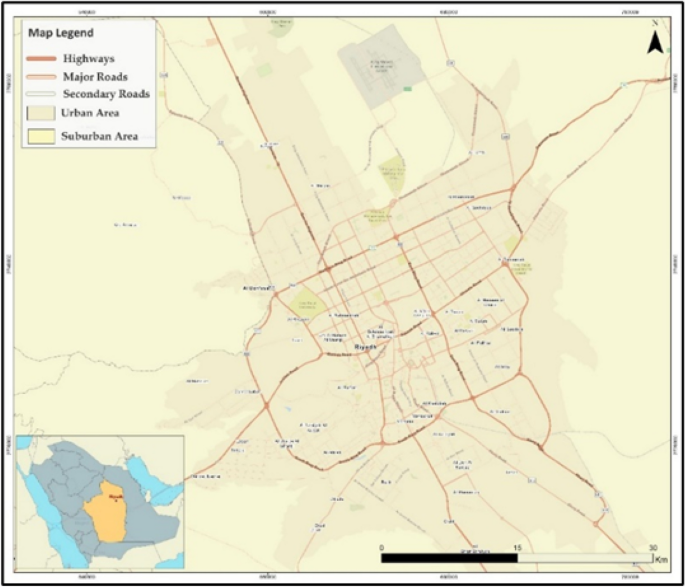
Green Riyadh is the Royal Commission for Riyadh City's urban afforestation programme, launched by King Salman on 19 March 2019 as one of four Riyadh megaprojects. Its stated targets are more than 7.5 million trees by 2030, an increase in green cover from 1.5% to about 9%, a rise in per-capita green space from 1.7 m2 to 28 m2 per person, and 545 km2 of total green area, at an investment of about US$11 billion. Irrigation is to come from treated sewage effluent, scaling from roughly 90,000 m3/day to 1,000,000 m3/day through some 1,350 km of new distribution networks.
The programme has never published a cumulative record of delivery. What exists in the public record are disconnected announcements: 31,000 trees along 144 km of main roads in the 2020 first phase; a December 2022 campaign launch covering 623,000 'trees and bushes' across 54 parks, 61 schools, 121 mosques, 78 parking sites and 176 km of roads, which is a forward commitment rather than a completion; and 15,000 trees and shrubs over a 5.2 km stretch at Shayb Ghudwanah. These figures are not additive, and 'trees and shrubs' is repeatedly substituted for 'trees'. No running total of trees actually planted has been released.
The independent evidence does not support the programme's narrative. Imam (2023), using multi-temporal Landsat NDVI and land surface temperature for 2018 against 2022, found that vegetated areas in Riyadh had not increased, that the total area of urban heat islands had increased, and that existing vegetation had made no impact on land surface temperature. Miah et al. (2026), over 1993-2023, found vegetation coverage declining from 0.771% to 0.674% while mean summer land surface temperature rose from 56.73 C to 59.89 C. Kafy and Altuwaijri (2024) did find vegetation gain of 32.14 km2 over thirty years, but against built-up growth of 777.76 km2 and a programme target of 545 km2 by 2030. Qwaider et al. (2026) found total green space did increase between 2018 and 2024, while reporting severe spatial inequity, with dense neighbourhoods below even the WHO 9 m2 per capita benchmark.
Critically, Alfarhood et al. (2025), writing sympathetically and proposing a monitoring system for the programme, state that current methods for evaluating green areas and measuring tree density are limited in precision and reliability, preventing effective monitoring and planning. That is a peer-reviewed statement that no reliable means of verifying this programme's progress currently exists.
The cooling claims are modelled, not measured. The widely quoted 1.5-2 C city-wide and 8-15 C local reductions are projections presented as objectives. The single observation-sounding claim, that Shayb Ghudwanah is about 5 C cooler than the rest of the city, is a self-reported single-site comparison published without methodology, instrumentation, control site or measurement period.
Water sustainability is conditional rather than demonstrated. Riyadh receives about 73 mm of mean annual precipitation, and the programme requires an eleven-fold increase in treated wastewater delivery. Elkatoury and Alazba (2024) show that evapotranspiration-based demand management could reduce water needs by 50-70% relative to higher-categorisation scenarios, which is also the critique: without species-appropriate irrigation management, demand is two to three times the optimised case. The treated-effluent transmission pipeline that the whole programme depends on had not been contracted at the time of research, with the Lot 16 EPC award expected in Q1 2027, three years before the 2030 target. No independent analysis models whether 1,000,000 m3/day can be delivered and sustained, nor the long-term soil salinisation risk of sustained effluent irrigation in a hyper-arid setting.
Two frequently repeated figures should be avoided. The US$23 billion headline covers all four Riyadh megaprojects combined, not Green Riyadh, which is about US$11 billion. And the estimate of roughly 1.53 billion m3 of treated water refers to the national Green Middle East / Saudi Green Initiative target of 10 billion trees, not to Green Riyadh's 7.5 million. Green Riyadh is catalogued here as a large, genuinely funded and genuinely under-construction programme that remains, on the published record, essentially unevaluated.
Read the full analysis: https://link.springer.com/article/10.1007/s43995-023-00030-4
Implementation detail (cost, timeline, staffing, conditions for success) is not yet available for this practice.
Do you run this practice? Claim it — verified implementers get a public contact pathway and can propose corrections.
Where this practice's information was retrieved from, and when.
Türkiye
Built on the former Atatürk Airport site, Istanbul's 121.5-hectare National Garden opened in November 2025 with 20,000+ trees and a …
Singapore
Singapore's national tree-planting programme, run by NParks under the Green Plan 2030, had planted over 832,000 of a targeted 1 …
Australia
Melbourne's 2012 Urban Forest Strategy set a 20-year target to double tree canopy from 20% to 40% by planting over …
Pakistan
Since January 2021, philanthropist-led Clifton Urban Forest has planted 700,000+ native saplings using the dense Miyawaki method on a reclaimed …
Open full copilot Grounded in cited practices — always check the sources.