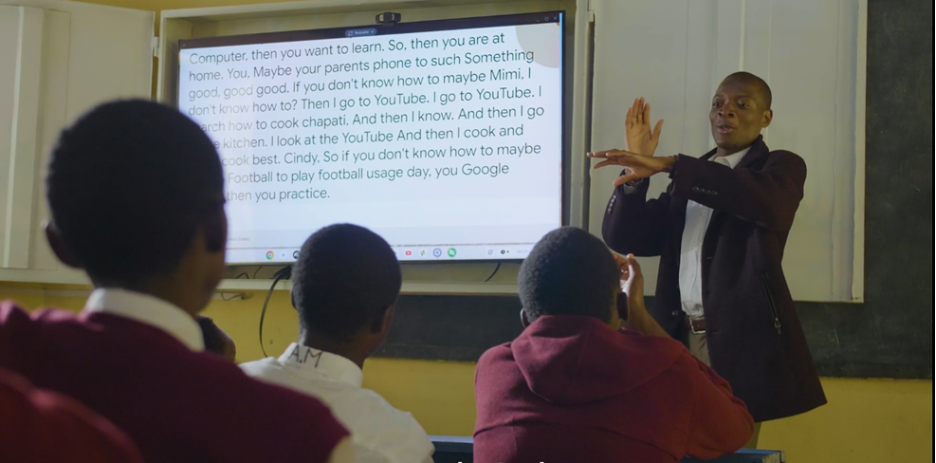
Kenyan NGO inABLE and Google piloted AI live captioning at Kambui Primary School for the Deaf, logging 700+ hours across 108 pupils, with self-reported gains and plans to expand to more Kenyan schools.
108+
Students reached (2025)
15
Teachers reached (2025)
700+ hours
Classroom hours of live-captioning use logged (2025)
4 classrooms + computer lab + common room
Classrooms/spaces equipped (2025)
Details
Maturity
Pilot
Promoter
inABLE
Period
2025–ongoing pilot
Keywords
live captioning, speech-to-text AI, deaf education, assistive technology, Africa
Context
Deaf pupils in Kenyan schools are taught primarily through sign language, but fluency varies widely among both teachers and students, and abstract subjects such as science and mathematics are especially hard to convey without a shared technical vocabulary; teachers report having to repeat instructions or write everything on the board to keep pupils following along.
Objectives
Pilot AI-driven real-time captioning of teachers' speech to improve comprehension and participation for deaf pupils.
Activities
In 2025, Nairobi-based nonprofit inABLE partnered with Google to pilot real-time captioning at Kambui Primary School for the Deaf in Kiambu County. Four classrooms, a computer lab and a common room were equipped with a 65-inch screen, a microphone and a laptop running Google's Live Transcribe app, which converts teachers' speech into text displayed live on the screen.
Results
inABLE reports the pilot reached over 108 students and 15 teachers, logging more than 700 hours of classroom use, with teachers and students describing improved comprehension and participation and less need to repeat instructions.
Conclusions
These outcomes are self-reported by the project lead rather than independently evaluated, and inABLE's own account flags that reliable internet, quality microphones and continuous teacher support are all necessary preconditions that are far from guaranteed in most Kenyan schools. inABLE and Google describe plans to replicate the model elsewhere in Kenya and beyond, but as of this pilot it remains a single-school deployment.
Implementation
Indicative cost
Low (< €50k) — The pilot equipped four classrooms, a computer lab and a common room at one school with a 65-inch screen, microphone and laptop each running Google's Live Transcribe app; costs are not itemised in public reporting.
Time to results
Short (< 1 year) — Piloted in 2025 and still ongoing as of the source reviewed, with inABLE and Google describing plans to replicate the model elsewhere in Kenya and beyond.
Staffing & skills
inABLE programme staff, Google (technology partner, Live Transcribe app), Kambui Primary School for the Deaf teachers
Conditions for success
Reliable internet connectivity
Quality microphones for accurate speech-to-text capture
Continuous teacher support and buy-in
Hardware provisioning (65-inch screen, microphone, laptop) per classroom
Common failure modes
Outcomes are self-reported by the project lead with no independent evaluation
Reliable internet, quality microphones and continuous teacher support are preconditions inABLE itself notes are far from guaranteed in most Kenyan schools
Remains a single-school deployment as of the pilot; replication elsewhere not yet evidenced
Where it fits
Governance type
NGO-corporate partnership pilot
Scale
single school (4 classrooms, 108 students, 15 teachers)
Income level
low-income
Commonly funded by
Philanthropic / foundation funding
Indicative funding routes for practices of this type — always check each programme's current calls and eligibility rules.
Do you run this practice?
Claim it —
verified implementers get a public contact pathway and can propose corrections.
Data sources
Where this practice's information was retrieved from, and when.
WeSign gives deaf and hard-of-hearing Hanoi primary pupils real-time, AI-scored feedback on fingerspelling and sign formation via webcam. A 30-participant …