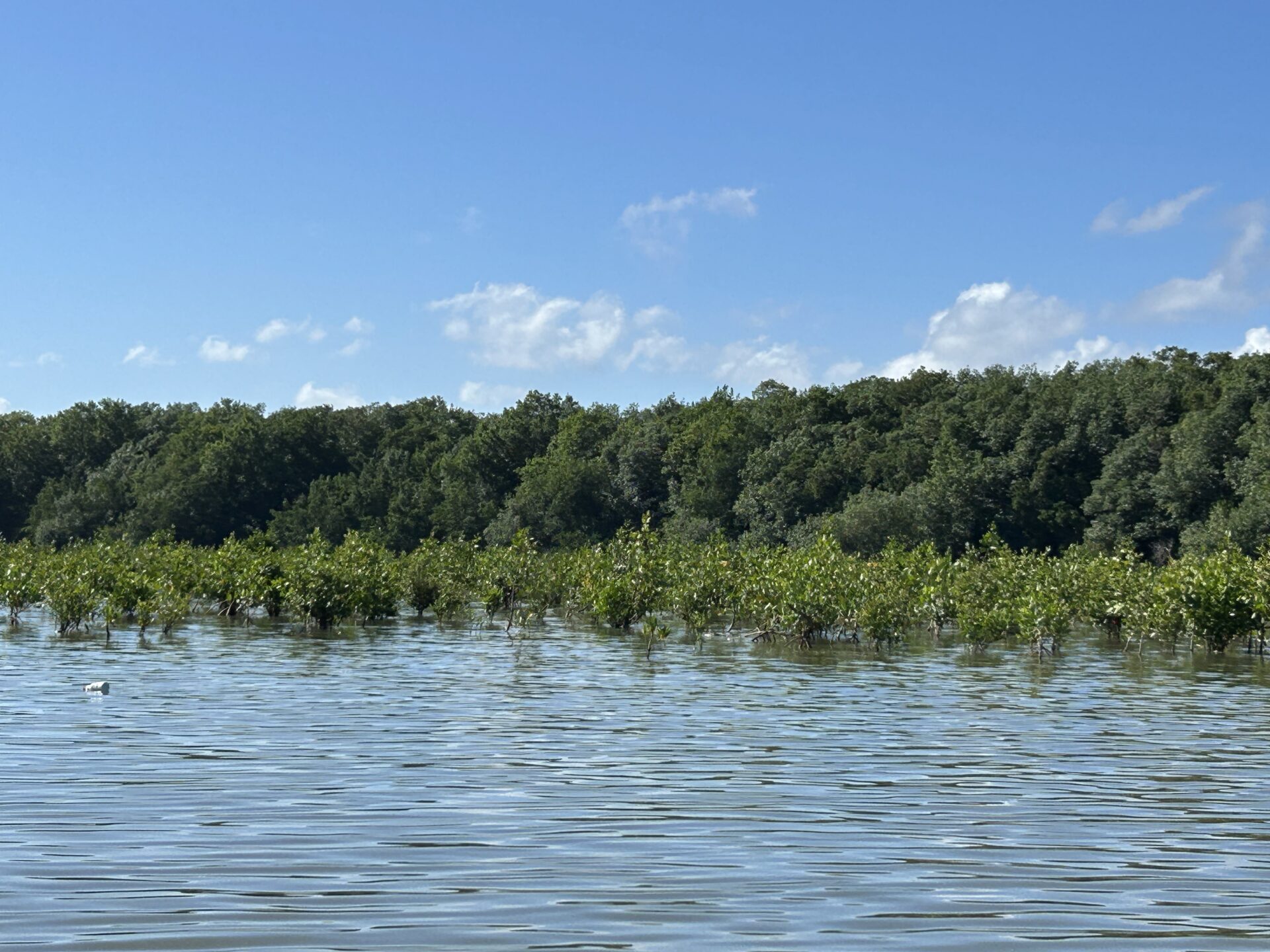
Global Nature Fund and the TUI Care Foundation, with local partner CEBSE, have restored 100+ hectares of mangrove in the Manglares del Bajo Yuna National Park near Sánchez since 2023, adding to 80 ha renaturalised earlier, to buffer Samaná Bay from coastal erosion and storms.
100+ hectares
Mangrove restored since 2023 (since September 2023)
80 hectares
Mangrove renaturalised in earlier phase (pre-2023)
The Dominican Republic's Samaná Bay coast, and the Manglares del Bajo Yuna National Park in particular, has lost mangrove cover to encroachment and degradation, even though roughly 70% of the country's population lives in areas exposed to flooding and severe storms, and mangroves are estimated to be worth USD 23,000–45,000 per hectare in avoided storm-surge damage. Since September 2023, the German NGO Global Nature Fund and the TUI Care Foundation, working with the local partner CEBSE, have been restoring mangrove forest in and around the national park near Sánchez.
Activities
The project has restored more than 100 hectares of mangrove forest since 2023, building on roughly 80 hectares renaturalised on the Samaná coast in an earlier phase. It has also trained 20 local guides as qualified tourism guides and added a suspension bridge and nature trail to support alternative livelihoods.
Results
The partners report a longer-term target of restoring over 200 hectares within the roughly 92,000-hectare protected area. The restoration is corporate-foundation financed and still short-running, with no independently published evaluation of survival rates, erosion reduction or storm-damage avoidance specific to this site yet available.
Conclusions
The disaster-risk-reduction impact of the restoration should be treated as plausible but not yet independently verified.
Implementation
Indicative cost
Medium (€50k–€500k)
Time to results
Medium (1–3 years) — Restoration under way since September 2023, building on ~80 ha from an earlier phase; longer-term target is over 200 ha within the ~92,000-hectare park.
Staffing & skills
Global Nature Fund (German NGO, international lead), TUI Care Foundation (corporate philanthropic funder), CEBSE — Centro para la Conservación y Ecodesarrollo de la Bahía de Samaná y su Entorno (local implementing partner)
Conditions for success
Local partnership with CEBSE for on-the-ground implementation
Alternative-livelihood components (20 trained tourism guides, suspension bridge, nature trail) to build community buy-in
Location within an existing ~92,000-hectare protected area (Manglares del Bajo Yuna National Park)
Common failure modes
No independently published evaluation yet of mangrove survival rates, erosion reduction or storm-damage avoidance specific to this site
Restoration is corporate-foundation financed and still short-running, so long-term funding continuity is unproven
Where it fits
Governance type
NGO-corporate foundation partnership with a local implementing partner
Scale
protected-area / regional coastal restoration
Income level
upper-middle-income (Dominican Republic)
Commonly funded by
Philanthropic / foundation funding
Indicative funding routes for practices of this type — always check each programme's current calls and eligibility rules.
Do you run this practice?
Claim it —
verified implementers get a public contact pathway and can propose corrections.
Data sources
Where this practice's information was retrieved from, and when.
Since 1994 Vietnam Red Cross mangrove replanting across eight coastal provinces has re-established roughly 9,000-12,000 hectares of forest, cutting wave …