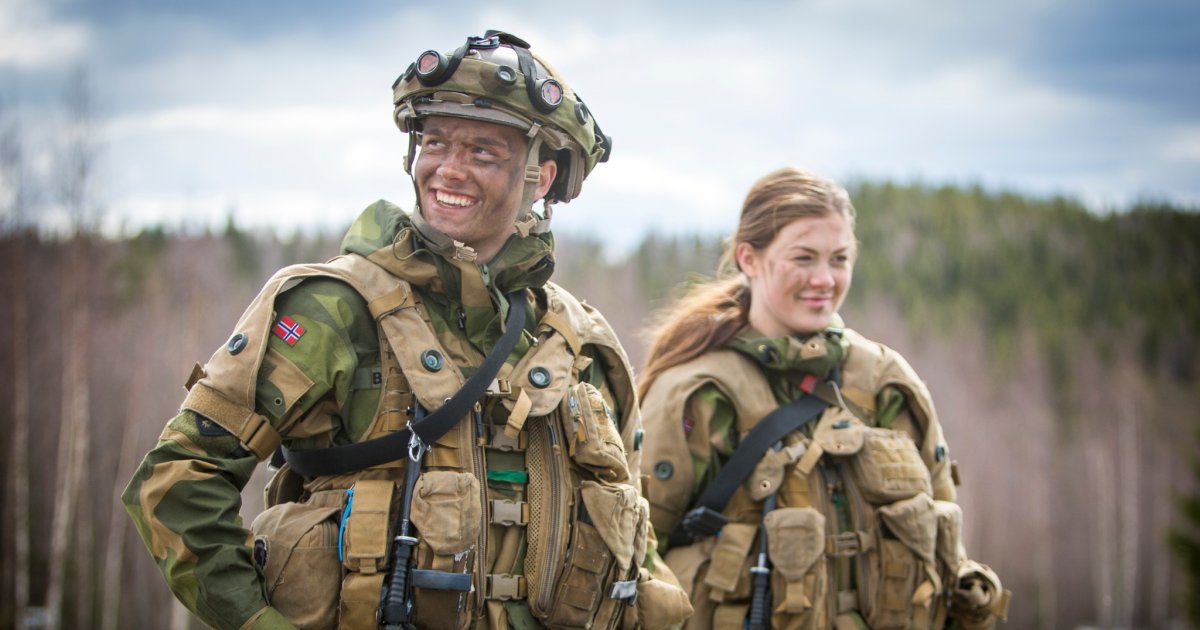
In 2015 Norway became the first NATO country to conscript women on equal terms with men. Their share of conscripts rose from ~13% (2014) to over 32% by 2024, though a 2020 internal survey found 63% of women under 30 in service had experienced sexual harassment.
13 %
Women's share of initial military service (baseline) (2014)
32.7 %
Women among successful conscript candidates (2016)
Conscripts selected annually from the screened pool
63 %
Women under 30 in service reporting sexual harassment (2020)
44
Sexual-assault reports logged in a single year (2019)
2
Sexual-assault reports pursued as formal complaints (2019)
18.9 %
Women among longer-term military employees
Details
Maturity
Established
Promoter
Norwegian Ministry of Defence (Forsvarsdepartementet) / Norwegian Armed Forces (Forsvaret)
Period
2015–present
Region (NUTS)
NO01
Keywords
defence, military service, conscription, women peace and security
Context
In 2015 Norway became the first NATO member and first European country to make military conscription obligatory for women on the same formal terms as men, with the first fully gender-neutral conscript class called up in 2016. The reform widened the pool of eligible 19-year-olds screened each year from roughly 30,000 to 60,000 candidates and made selection formally sex-blind, with the Armed Forces choosing about 8,000-10,000 conscripts from that pool.
Results
Before the reform, women made up roughly 13% of those in initial military service in 2014, according to the Norwegian Ministry of Defence. By the 2016 intake, 32.7% of successful conscript candidates were women (War on the Rocks); by 2020, women made up about a third of those completing initial service; and by the end of 2024 the Ministry of Defence reported the figure had stayed above 32%, describing it as "one in three conscripts."
Conclusions
A 2020 internal Armed Forces study (the "MOST" survey), cited by SecurityWomen.org, found that 63% of women under 30 in the forces reported experiencing sexual harassment, and a 2019 report logged 44 sexual-assault reports in a single year with only two pursued as formal complaints. SecurityWomen.org also notes that although roughly a third of conscripts are now women, only about 18.9% of longer-term military employees are women, suggesting intake gains have not yet fully carried through into retention.
Implementation
Implementation detail (cost, timeline, staffing, conditions for success) is not yet available for this practice.
Commonly funded by
National / regional programmes
Indicative funding routes for practices of this type — always check each programme's current calls and eligibility rules.
Do you run this practice?
Claim it —
verified implementers get a public contact pathway and can propose corrections.
Data sources
Where this practice's information was retrieved from, and when.
Sociological research by Kyiv-Mohyla Academy (2015) documented women serving in combat roles without recognition, directly driving Ukraine's 2018 law opening …