Cheonggyecheon Stream Restoration — Seoul's Highway-to-River Nature-Based Corridor
South Korea
Seoul removed a 5.6km elevated highway and daylighted the buried Cheonggyecheon stream, cutting local air pollution 35%, raising species counts …
France · Paris · See the France profile · See the Paris profile
Evidence: Quasi-experimental Top 89% 27/100 · Ask Evidence Copilot about this practice
Paris is de-paving and greening its 760 public schoolyards to create 'climate shelters'; a 2018–2023 EU-funded pilot instrumented 10 sites and measured perceived-temperature drops of 3–8°C, informing citywide rollout targeted for 2040.
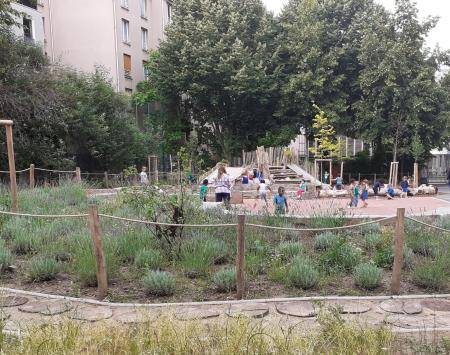
FR10Under the Paris Climate Plan since 2017, the goal is to convert the city's 760 public pre-, elementary and middle-school playgrounds from asphalt to permeable, vegetated 'oasis' courtyards by 2040, removing impermeable surfaces and adding trees, planting beds and higher-albedo materials.
A pilot phase funded by the EU's Urban Innovative Actions (UIA) programme, from 2018 to 2023, instrumented and evaluated 10 schoolyards with field microclimate measurements.
Published studies and preprints recorded perceived-temperature reductions of 3–6°C typically and up to 8°C during heat waves in the renovated pilot schoolyards, compared with unrenovated asphalt yards.
The rigorous instrumented evaluation covers only the 10 UIA pilot sites; the wider rollout to all 760 schools is a multi-decade target through 2040, and standardised outcome data across the full school portfolio is not yet available.
European Urban Initiative National / regional programmes Own resources / municipal budget
Indicative funding routes for practices of this type — always check each programme's current calls and eligibility rules.
Do you run this practice? Claim it — verified implementers get a public contact pathway and can propose corrections.
Where this practice's information was retrieved from, and when.
South Korea
Seoul removed a 5.6km elevated highway and daylighted the buried Cheonggyecheon stream, cutting local air pollution 35%, raising species counts …
Sweden
Facing chronic flooding, Malmo's 1997-2002 Augustenborg retrofit added ~10,000 m2 of green roofs and open stormwater channels/ponds across a 1950s …
Micronesia
Since 2002 the Micronesia Conservation Trust has mobilised USD 100 million, including a USD 50 million endowment, funding 150+ protected …
South Africa
A US$3.5m GEF project (2012–2018) trained over 5,000 people in integrated fire management across four Western Cape communities in South …
Open full copilot Grounded in cited practices — always check the sources.