Protecting Country Against Invasive Species — Indigenous Ranger-Led Control (Northern Australia)
Australia
Australia's Indigenous Rangers Program funds 40+ ranger groups across northern Australia to control feral pigs, cats and invasive weeds like …
Norway · Tana · See the Norway profile
Evidence: Observational / pre–post Top 89% 27/100 · Ask Evidence Copilot about this practice
Norway's Environment Agency funds fish traps on 53 of 63 affected rivers — including a 400m trap at Seida on the Tana River that caught 7,666 invasive pink salmon in 2023 — to protect Atlantic salmon, itself now at risk of extinction, from a growing biennial invasion.
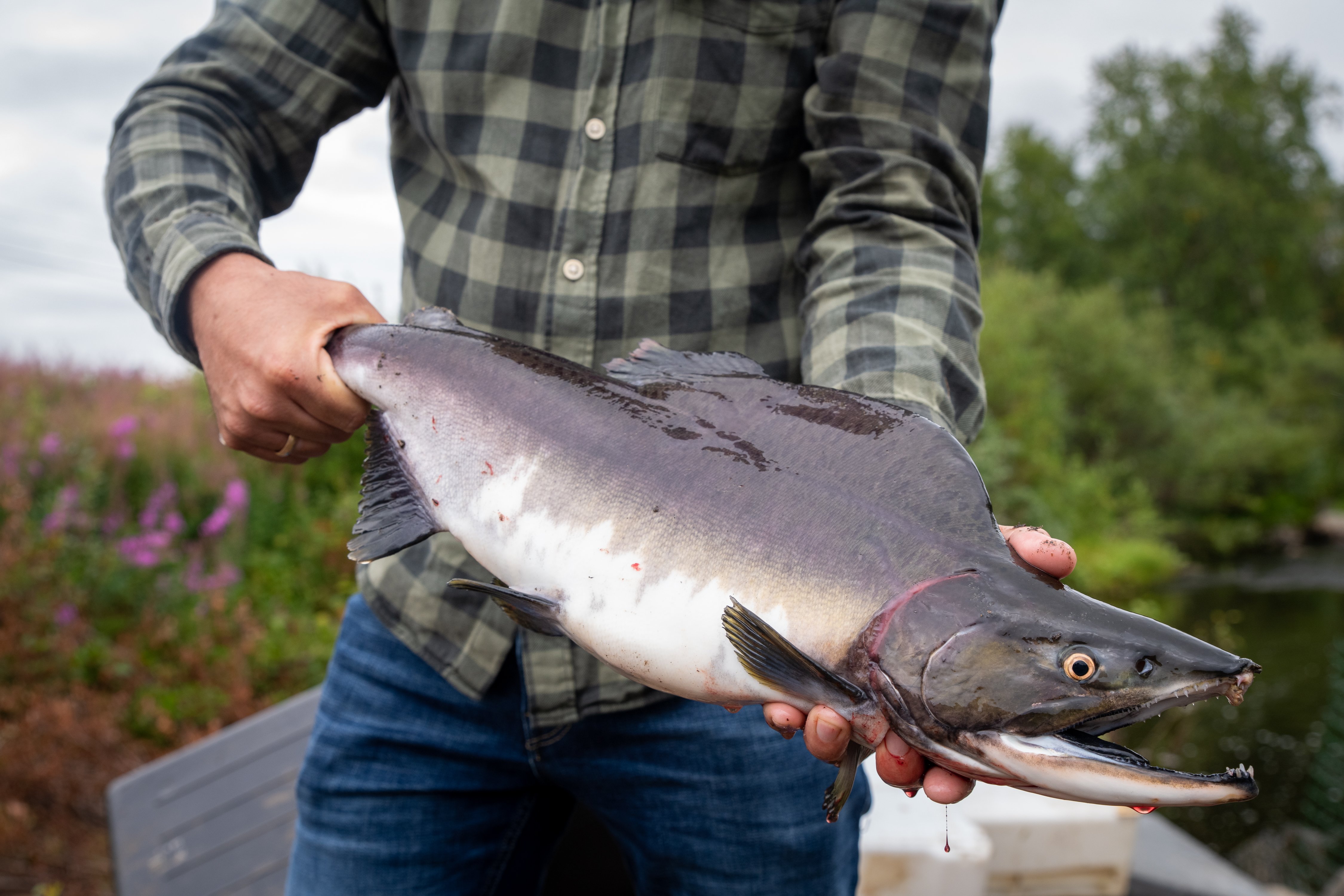
NO07Pink salmon (Oncorhynchus gorbuscha), originally introduced to Russia's Kola Peninsula in the mid-20th century, now invade Norwegian rivers biennially, arriving in odd years (2021, 2023, 2025) with further recurrence expected in 2027. Norway's Environment Agency (Miljodirektoratet) describes native Atlantic salmon as 'at risk of extinction', with only approximately 323,000 wild spawners counted nationally in 2024. The Tana River, managed jointly with cross-border partners including Statsforvalteren i Troms og Finnmark, is one of the country's most significant salmon rivers.
To trap and remove invasive pink salmon before they can spawn and compete with native Atlantic salmon, while releasing incidentally-caught Atlantic salmon alive, in the context of a nationally expanding, state-funded control programme.
Miljodirektoratet, the Norwegian Veterinary Institute (Veterinaerinstituttet) and Statsforvalteren i Troms og Finnmark operate fish traps on Norwegian rivers during biennial pink salmon runs. The flagship installation is a 400-metre pole-row trap at Seida on the Tana River, run by the Veterinary Institute. By 2025, state-funded control measures were in place on 63 rivers nationally, with 53 fitted with fish traps. Trapped pink salmon are euthanised; incidentally caught Atlantic salmon are released alive.
In 2023, 481,463 pink salmon were caught or observed nationally, including 7,666 at the Seida trap on the Tana River; officials nonetheless described the Tana trap as 'a pilot rather than a solution' since 'considerable quantities' of fish passed through unblocked that year. By mid-summer 2025, roughly 150,000 fish had been caught nationally, approximately 30,000 of them from the Tana River alone. On a single documented day, 47 incidentally-caught Atlantic salmon were released alive. A peer-reviewed ecosystem study on the Skallelv river found that white-tailed eagle sightings rose from a mean of 0.38 to 10.9 per day during the 2021-2022 pink salmon invasion, as carcasses became available as a food source.
Catch totals have grown across successive biennial cycles despite expanded trapping infrastructure, though available sources do not clarify whether this reflects rising invasion pressure, improved trapping efficiency, or both. The programme is transparently scaled and reported annually, but suppression efficacy at flagship sites like Tana remains unconfirmed by officials' own account.
National / regional programmes
Indicative funding routes for practices of this type — always check each programme's current calls and eligibility rules.
Do you run this practice? Claim it — verified implementers get a public contact pathway and can propose corrections.
Where this practice's information was retrieved from, and when.
Australia
Australia's Indigenous Rangers Program funds 40+ ranger groups across northern Australia to control feral pigs, cats and invasive weeds like …
Romania
The EU-funded GreenDanube LIFE project (2006-2010) cleared 12.2 hectares of invasive Amorpha fruticosa and added 953.5 hectares of Danube floodplain …
Netherlands
Since 1941, Dutch regional water boards have run a nationwide muskrat/coypu control programme to stop dike-burrowing damage; in 2025 they …
Portugal
EU LIFE programme (2019–2025, LIFE18 NAT/PT/000927) removed feral cats and invasive plants from Ria Formosa's barrier islands; Audouin's Gull nests …
Open full copilot Grounded in cited practices — always check the sources.