Vanuatu Women's Centre - National CAVAW Network Against Family and Sexual Violence
Vanuatu
Since 1992, the Vanuatu Women's Centre and its 45 community-based CAVAW committees have delivered thousands of counselling sessions a year …
Eswatini · Manzini · See the Eswatini profile · See the Manzini profile
Evidence: Descriptive / self-reported Top 59% 59/100 · Ask Evidence Copilot about this practice
Since 1990, Eswatini's SWAGAA has provided counselling, shelter referrals and legal support to gender-based violence survivors; it recorded 1,172 cases in five months of 2024 and helped drive the 2018 Sexual Offences and Domestic Violence Act, per Human Rights Watch.
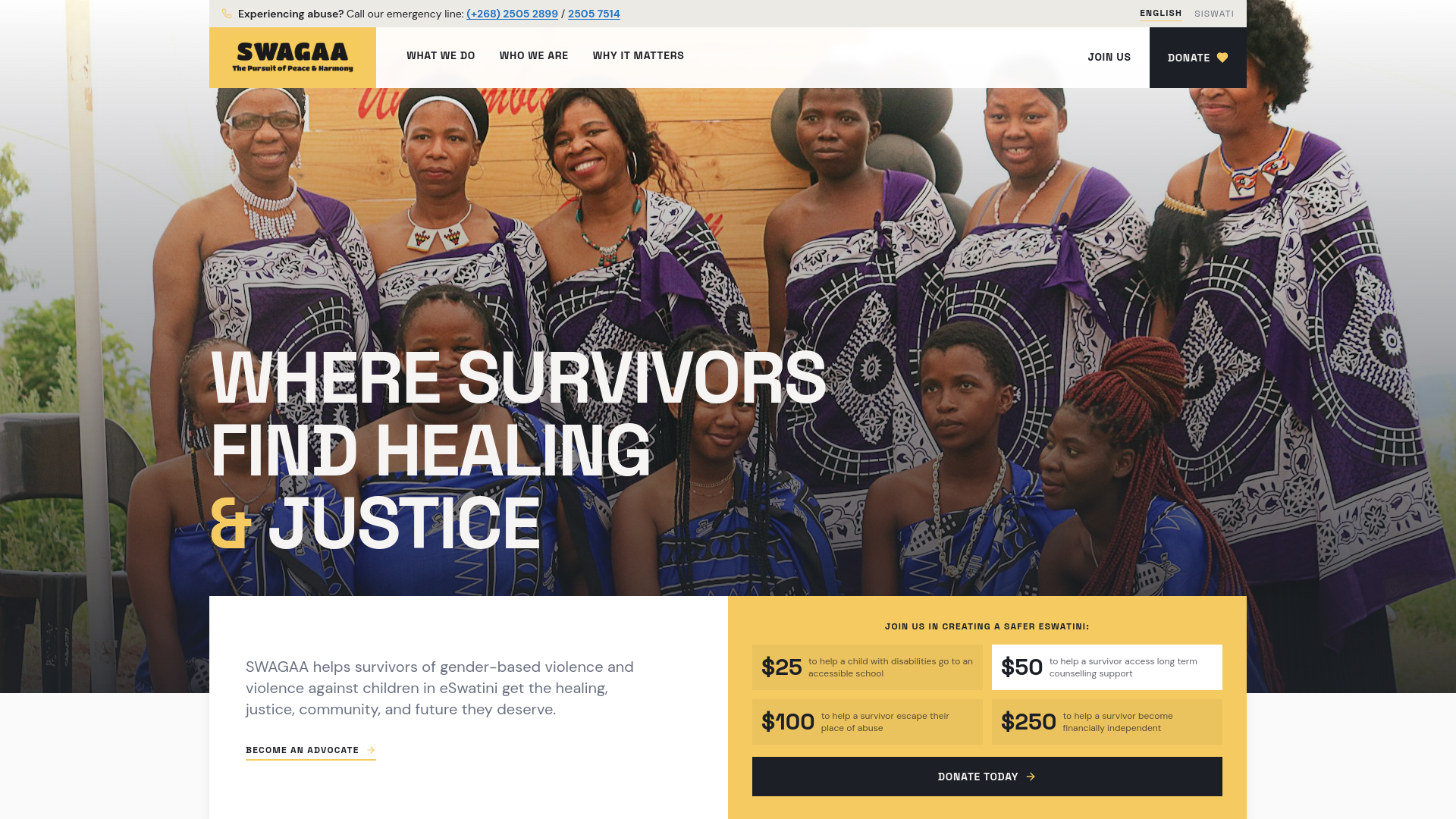
The Swaziland Action Group Against Abuse (SWAGAA), based in Manzini, has worked since 1990 to prevent gender-based violence (GBV) and support survivors in Eswatini, marking over three decades of continuous operation by its 30th anniversary in 2020.
SWAGAA provides counselling, shelter referrals and legal support to GBV survivors, and was among the civil-society organisations that pushed for Eswatini's 2018 Sexual Offences and Domestic Violence (SODV) Act, a landmark law criminalising domestic and sexual violence.
Human Rights Watch's World Report 2025 cites SWAGAA data showing 1,172 GBV cases recorded between January and May 2024, including 260 cases in May alone, with emotional abuse the most common form and roughly 85% of incidents occurring in domestic settings between people with existing relationships.
Human Rights Watch notes that implementation of the SODV Act has lagged the legislation itself: the Act remains underfunded, inter-departmental coordination is weak, and Eswatini's first government-run survivor shelter only opened in 2021 — leaving NGOs like SWAGAA to fill large service gaps, against a backdrop of widespread underreporting.
Philanthropic / foundation funding
Indicative funding routes for practices of this type — always check each programme's current calls and eligibility rules.
Do you run this practice? Claim it — verified implementers get a public contact pathway and can propose corrections.
Where this practice's information was retrieved from, and when.
Vanuatu
Since 1992, the Vanuatu Women's Centre and its 45 community-based CAVAW committees have delivered thousands of counselling sessions a year …
Kenya
A four-year, €278,606 COVAW project trained women, youth and persons with disabilities in Kwale County, Kenya, to engage the budget …
Argentina
Since the 2015 'Ni Una Menos' marches, the civil-society observatory 'Ahora Que Sí Nos Ven' has tracked Argentina's most-cited independent …
Seychelles
In June 2020 Seychelles replaced its 2000 family-violence law with a Domestic Violence Act covering psychological, economic and sexual abuse …
Open full copilot Grounded in cited practices — always check the sources.