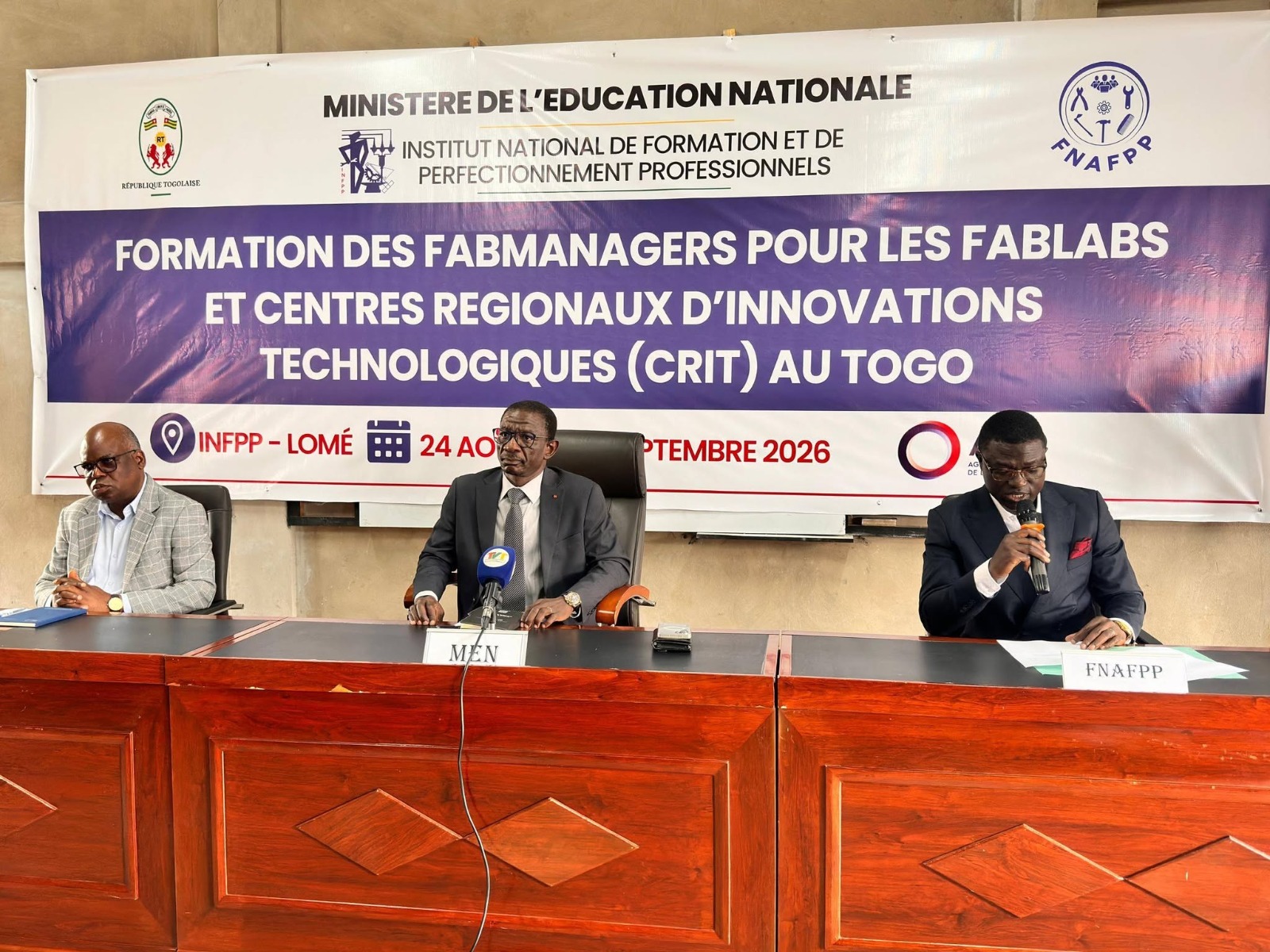
Togo's Ministry of National Education trained 101 newly recruited teachers as 'Fabmanagers' to run FabLab innovation spaces teaching AI, robotics, coding, IoT and 3D printing in colleges and science lycées across all seven educational regions, starting August 2026.
101
Fabmanagers trained
1,100+
Additional teachers given AI/digital orientation
7
Educational regions covered
Details
Maturity
Pilot
Promoter
Togo Ministry of National Education / INFPP
Period
August 2026
Keywords
K-12 education, teacher training, STEM, vocational training
Context
In August 2026, Togo's Ministry of National Education, led by Minister Mama Omorou, launched a nationwide FabLab and CRIT (technological innovation resource centre) programme to bring hands-on AI, robotics, coding, Internet-of-Things and 3D-printing instruction into public colleges and scientific lycées.
Objectives
Build teacher capability to run FabLabs and teach AI-adjacent STEM subjects, extending access to hands-on technology education beyond the capital Lomé to all seven of Togo's educational regions.
Activities
101 newly recruited teachers, selected through the national teacher-recruitment competition, were trained as 'Fabmanagers' at the Institut national de formation et de perfectionnement professionnels (INFPP) in Lomé, combining two weeks of general pedagogical preparation with one month of specialised instruction in operating FabLabs and teaching AI-adjacent STEM subjects, before deployment to colleges and scientific lycées across all seven regions. A parallel cohort of over 1,100 newly recruited teachers received a shorter two-week orientation covering digital transformation, robotics, coding and AI alongside reinforced mathematics and physics, running simultaneously across all seven regions from 10 to 24 August 2026.
Results
No independent measurement of student learning outcomes has been published; the documented evidence covers programme design, teacher-training completion and geographic deployment rather than downstream impact on pupils.
Conclusions
The programme has a durable institutional home (national teacher-recruitment pipeline plus the existing public INFPP training institute) and deliberately reaches beyond the capital, but is only weeks old with no classroom-impact evidence yet.
Implementation
Indicative cost
Medium (€50k–€500k) — A national teacher-training pipeline delivered via an existing public institute (INFPP); costs are staff salaries, training logistics and FabLab equipment for colleges/lycées in all seven regions, but no budget figure is published.
Time to results
Medium (1–3 years) — Training ran two weeks of general pedagogy plus one month of specialised Fabmanager instruction, alongside a separate two-week orientation for 1,100+ teachers from 10-24 August 2026, ahead of the August 2026 launch.
Staffing & skills
101 newly recruited teachers trained as Fabmanagers, 1,100+ newly recruited teachers given a 2-week AI/digital orientation, INFPP (Institut national de formation et de perfectionnement professionnels) as training provider
Conditions for success
National teacher-recruitment competition used as the selection pipeline for trainees
Institutional home in an existing public training institute (INFPP)
Deployment across all seven educational regions to avoid capital-only concentration
Common failure modes
No independent measurement of student learning outcomes yet; deployment has outpaced evidence of classroom impact
Rural FabLab equipment and connectivity coverage is not yet quantified
Commonly funded by
National / regional programmes
Indicative funding routes for practices of this type — always check each programme's current calls and eligibility rules.
Do you run this practice?
Claim it —
verified implementers get a public contact pathway and can propose corrections.
Data sources
Where this practice's information was retrieved from, and when.
Iceland's education directorate and teachers' union gave ~7% of the country's teachers (~300 primary/lower-secondary, ~260 upper-secondary) free access to Claude …