Eddleston Water Project — Whole-Catchment Natural Flood Management Trial in the Scottish Borders
United Kingdom
A decade-plus monitored NFM experiment across 24 farms: 300,000+ native trees, ~40 leaky ponds and ~136 flow restrictors; reported ~30% …
Canada · Riske Creek · See the Canada profile
Evidence: Descriptive / self-reported Top 14% 60/100 · Ask Evidence Copilot about this practice
Since 2019, the Yunesit'in and Xeni Gwet'in First Nations have revived spring and fall cultural burning across Tsilhqot'in Territory, British Columbia, training 60+ community members and treating 400+ hectares in 2023 to cut wildfire fuel loads and restore grassland health.
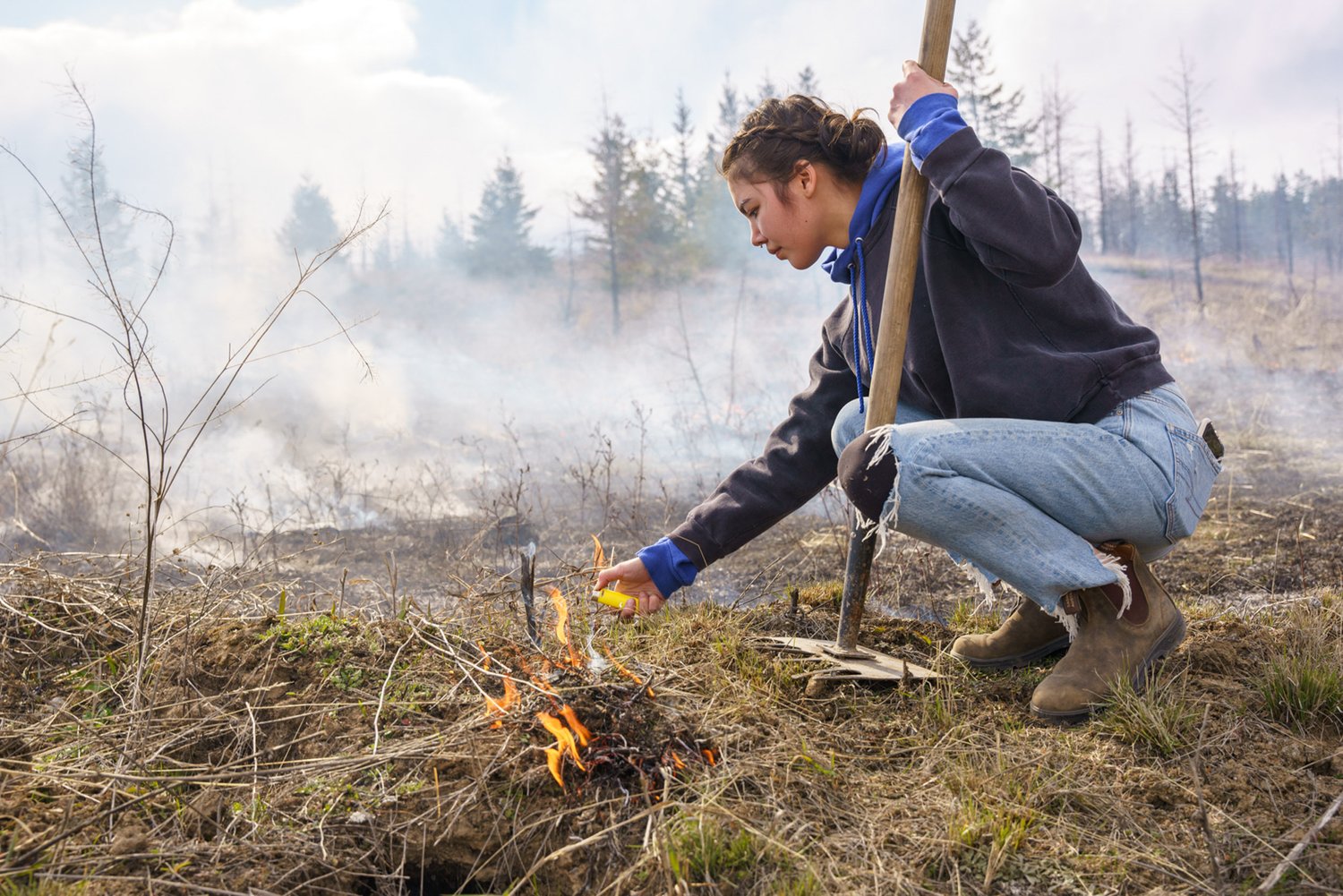
Following British Columbia's record 2017 wildfire season, the Yunesit'in and Xeni Gwet'in First Nations (Tsilhqot'in Nation, Chilcotin region) partnered with the non-profit Gathering Voices Society in 2018 to rebuild a fire stewardship programme grounded in traditional burning knowledge.
Revive traditional spring and fall cultural burning to reduce wildfire fuel loads and restore grassland-forest health, under the guidance of former Yunesit'in Chief Russell Myers Ross and Australian Aboriginal fire practitioner Victor Steffensen.
Cultural burns have been conducted every spring and fall since 2019 on Tsilhqot'in Title lands and in the Dasiqox Tribal Park, funded through a tripartite federal-provincial-Tsilhqot'in Nation arrangement.
By 2023, a core crew of 15 regular fire stewards, supported by a wider pool of 60 community members trained over five years (youth, women and Elders), applied fire to more than 400 hectares in a single season. Researchers describe it as the longest continuously running Indigenous cultural burning programme in British Columbia.
Programme leadership is candid about limits: Myers Ross has said the community wants to scale up across the full territory but 'we don't have all the tools that our ancestors did.' A 2022 FACETS paper catalogues ongoing legal/regulatory barriers (permitting, fire-suppression policy, liability) constraining scale-up, and a 2025 study notes carbon-finance for this work 'remains only exploratory, not yet implemented.'
Do you run this practice? Claim it — verified implementers get a public contact pathway and can propose corrections.
Where this practice's information was retrieved from, and when.
United Kingdom
A decade-plus monitored NFM experiment across 24 farms: 300,000+ native trees, ~40 leaky ponds and ~136 flow restrictors; reported ~30% …
Iceland
Since 2007, Iceland's Hekluskógar project has enlisted 210+ landowners to re-establish native birch woodland around the Hekla volcano, planting 2.3M+ …
United States of America
A 50/50 USACE-SFWMD project backfilled 22 miles of the C-38 flood-control canal and re-carved 44 miles of the Kissimmee River's …
Denmark
Denmark re-meandered the channelised Skjern River from 19 to 26 km across 875 ha of rewetted floodplain (2001-2004), an EU …
Open full copilot Grounded in cited practices — always check the sources.