Restauration du système en cascade de bassins-villages, centre-nord du Sri Lanka
Sri Lanka
Le réseau d'irrigation en cascade vieux de 2000 ans du Sri Lanka, désigné système du patrimoine agricole par la FAO …
Slovénie · Voir le profil de Slovénie
Preuves: Observationnel / avant-après · Demandez à Evidence Copilot à propos de cette pratique
None
SI03The progress of agriculture in Vipava Valley ( Cvejić et al., 2020 ) is endangered by drought, flooding, and strong winds that caused more than €15 million in damage between 2012 and 2014. Most recent climate change projections for the 21 st century point to further worsening of climate hazards to current agricultural settings. The average annual temperature and the summer evapotranspiration will increase by 1.8 °C and 6%, respectively, according to climate simulations that used the moderately optimistic RCP4.5 scenario. Furthermore, climate change projections in the Vipava Valley indicate that agriculture will be challenged with more heatwaves and prolonged periods without rain, resulting in higher crop water demand. Simulations project an increase in warm (maximum temperature exceeding 25 °C) and hot days (maximum temperature exceeding 30 °C). The Slovenian Environment Agency reports that the number of scorching maximum daily temperatures will increase from 12 to 24 times per year by the end of the 21st century. Moreover, farmers will face an increased number of days with extreme precipitation events ( Cvejić et al., 2020 ), leading to higher soil erosion and more challenging growth conditions for crops. An increase of days with precipitation above 20 mm is projected in the valley by the end of the 21 st century. The impacts of climate change on agriculture were assessed and mapped during the LIFE VIVaCCAdapt project, revealing high vulnerability of the sector in the Vipava Valley, due to its high exposure, high sensitivity, and low adaptive capacity. Evapotranspiration will increase plant water requirements and the pressure on local water resources. With irrigation, farmers ensure that plants receive adequate quantities of water for their growth in critical development periods. However, farms that practice irrigation scheduling based on experience and assumptions to regulate water availability for plants, tend to both overuse water resources and to deliver the water too late.
The objective is to improve the preparedness for drought together with farmers by introducing a Decision Support System for Irrigation (DSSI) to deliver water to plants both timely and in optimal quantity. The objective was to optimise water and energy use also reducing CO 2 emissions. The final goal is to increase both climate change resilience of agriculture in the valley and to contribute to climate change mitigation.
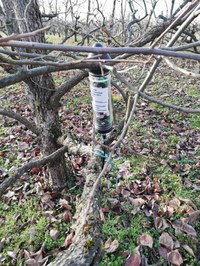
The LIFE VIVaCCAdapt project applied a newly developed Decision Support System for Irrigation (DSSI) to deliver climate change adaptation measures comprising timely and efficient irrigation to crops. The system ( Cvejić et al., 2020 ) delivers a recommendation for irrigation based on weather forecast, water retention properties of the soil, real-time soil water content measurement (monitoring data), plant water requirements in given phenological phases, type of plant and of irrigation system. Data are collected on parcels, via a soil-water content sensor, which sends the collected data to the central server via the communication unit. Based on the data collected on the farmer's plot, the system calculates the recommended time and amount of water for irrigation. Calculations were started for every day during the growing season. Results have been provided to the 35 farmers (covering an area of approximately 40 ha) that were involved in the project, after signing a specific agreement. Farmers are provided with the recommended amount of irrigation water for five days in advance. Farmers also get a graph showing the measured amount of water in the soil for the past five days and the changes in the phenological phases of the plants. Farmers can access this data via email or a web-based interface and view the data on various devices. All recommendations were delivered for free during the LIFE ViVaCCAdapt project. After the project ended, the DSSI was transferred to the national level where it is managed by the Slovenian Environment Agency. The agency is a part of the Ministry for environment and spatial planning of the Republic of Slovenia. DSSI is now a public system available for use by every farmer in Slovenia, free of charge.
The total budget of the ViVaCCAdapt project, is EUR 869028. The European Commission contributed 60%, the Ministry of the Environment and Spatial Planning of the Republic of Slovenia 20% of the project's eligible costs. The project partners provided the rest. Of the total value of the project, 147,200 euros are intended for the establishment of DSSI. The DSSI allows saving water resource in a future looking perspective of increasing temperature and decreasing of precipitation. Other co-benefits of a more efficient irrigation include energy savings, with related benefits in terms of costs and greenhouse gas emissions. The initiative also led to increased awareness of farmers on the topic of climate change. Co-designing and ranking of adaptation measures by involving farmers of Vipava Valley is expected to lead to an increased sense of ownership of the adaptation strategy developed in the project and an increased attention on the use of water resources.
Over the six-year process, the farmers started using DSSI gradually. Before entering the project, farmers based their irrigation decisions on their experience and general assumptions. Then, farmers began integrating data from the real-time soil-water monitoring into their decisions. When the DSSI was introduced, farmers slowly started using daily irrigation recommendations. The mid-term evaluation, based on field data and simulations in 2019, showed that if farmers continue to use DSSI, they will achieve a 25% reduction in total irrigation-volume consumption, a 24% reduction in energy requirements, and a 24% reduction in CO 2 emissions (Cvejić et al., 2020). Although the final evaluation from the period 2020-2021 is still underway, the preliminary results indicate some of the farmers exceeded good results from 2019. Some of the limiting factors that challenge the DSSI implementation and future development include: functioning of on-field equipment; their regular maintenance is necessary for a good functioning of the DSSI; actual possibility of using water for irrigation: sometimes, the needed water was not available for irrigation due to maintenance of the irrigation systems and related water infrastructure; future financing of maintenance, and development of public DSSI.
Les détails de mise en œuvre (coût, calendrier, personnel, conditions de réussite) ne sont pas encore disponibles pour cette pratique.
LIFE Programme National / regional programmes
Pistes de financement indicatives pour des pratiques de ce type — vérifiez toujours les appels en cours et les règles d'éligibilité de chaque programme.
Vous portez cette pratique ? Revendiquez-la — les porteurs vérifiés obtiennent un contact public sur la page et peuvent proposer des corrections.
D'où proviennent les informations de cette pratique, et quand.
Sri Lanka
Le réseau d'irrigation en cascade vieux de 2000 ans du Sri Lanka, désigné système du patrimoine agricole par la FAO …
Malte
L'opérateur public de Malte traite les eaux usées à Ta' Barkat et Sant'Antnin pour produire de la « New Water …
Indonésie
Les recettes des billets d'entrée aux terrasses de riz de Jatiluwih, classées par l'UNESCO, sont réparties entre le gouvernement de …
Italie
Ouvrir le copilote complet Fondé sur des pratiques citées — vérifiez toujours les sources.