EU AI Act — education AI as 'high-risk'
Belgium
The EU AI Act classifies AI for admissions, grading, steering learning and exam monitoring as 'high-risk' — mandating risk management, …
South Korea · Sejong · See the South Korea profile · See the Sejong profile
Top 95% 20/100 · Ask Evidence Copilot about this practice
Korea planned mandatory AI digital textbooks (maths, English, informatics) for 2025, but after rushed rollout, teacher-training gaps and low uptake, the law of Aug 2025 downgraded them to optional 'educational material'; a state audit found 8.1% average use.
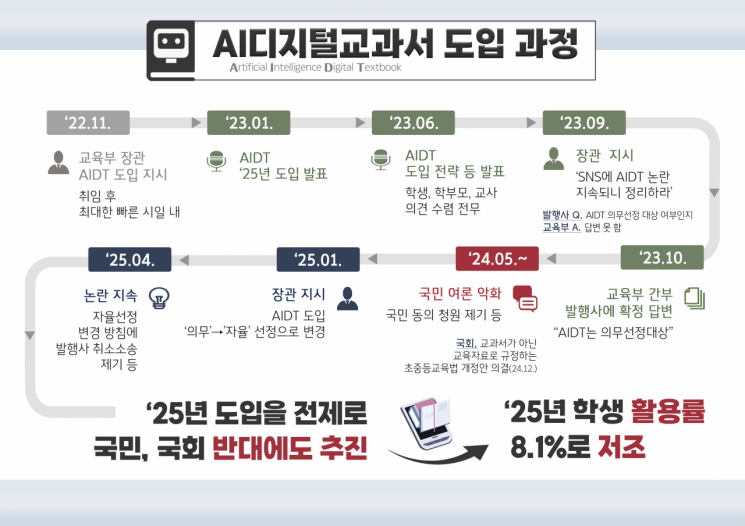
The Ministry of Education announced the AI Digital Textbook (AIDT) plan in January 2023, aiming for full-scale introduction in the 2025 school year, and told publishers in October 2023 that all schools would be required to adopt it. In January 2025 the ministry reversed course and let schools decide autonomously.
Among schools that chose to adopt it (March–May 2025), the Board of Audit and Inspection found average utilisation (use on more than 10 days) of 8.1%, and 60% of students never accessed the system. A July 2025 survey of 513 English and maths teachers at pilot schools found 85.5% had never used it or had stopped; the most common reason (53%) was that it was merely a digitised paper textbook. A teachers' union survey (Dec 2024, 2,626 teachers) reported 98.5% saying prior training was insufficient; this is an advocacy-group survey.
On 4 August 2025 the National Assembly amended the Elementary and Secondary Education Act to define AIDT as educational material rather than textbook (promulgated 14 August); principals now decide on use and schools fund it. The audit (17 Dec 2025) listed six cautions, including a decision process of seven internal meetings without external input. It reports no learning-outcome evidence. The case is a cautionary lesson on piloting, teacher preparation and evidence before mandating AI at national scale.
Read the full analysis: https://view.asiae.co.kr/en/article/2025121614431525429
Implementation detail (cost, timeline, staffing, conditions for success) is not yet available for this practice.
Do you run this practice? Claim it — verified implementers get a public contact pathway and can propose corrections.
Where this practice's information was retrieved from, and when.
Belgium
The EU AI Act classifies AI for admissions, grading, steering learning and exam monitoring as 'high-risk' — mandating risk management, …
Singapore
Singapore's Ministry of Education paired a national AI-in-Education Ethics Framework — Agency, Inclusivity, Fairness, Safety — with AI tools built …
United Kingdom
Oxford gave all staff and students free ChatGPT Edu (GPT-5) from 2025/26 after a year-long ~750-user pilot, backed by an …
Greece
Greece's May 2026 Ministerial Decision regulates AI in all public secondary schools: it bans fully automated assessment and profiling, makes …
Open full copilot Grounded in cited practices — always check the sources.