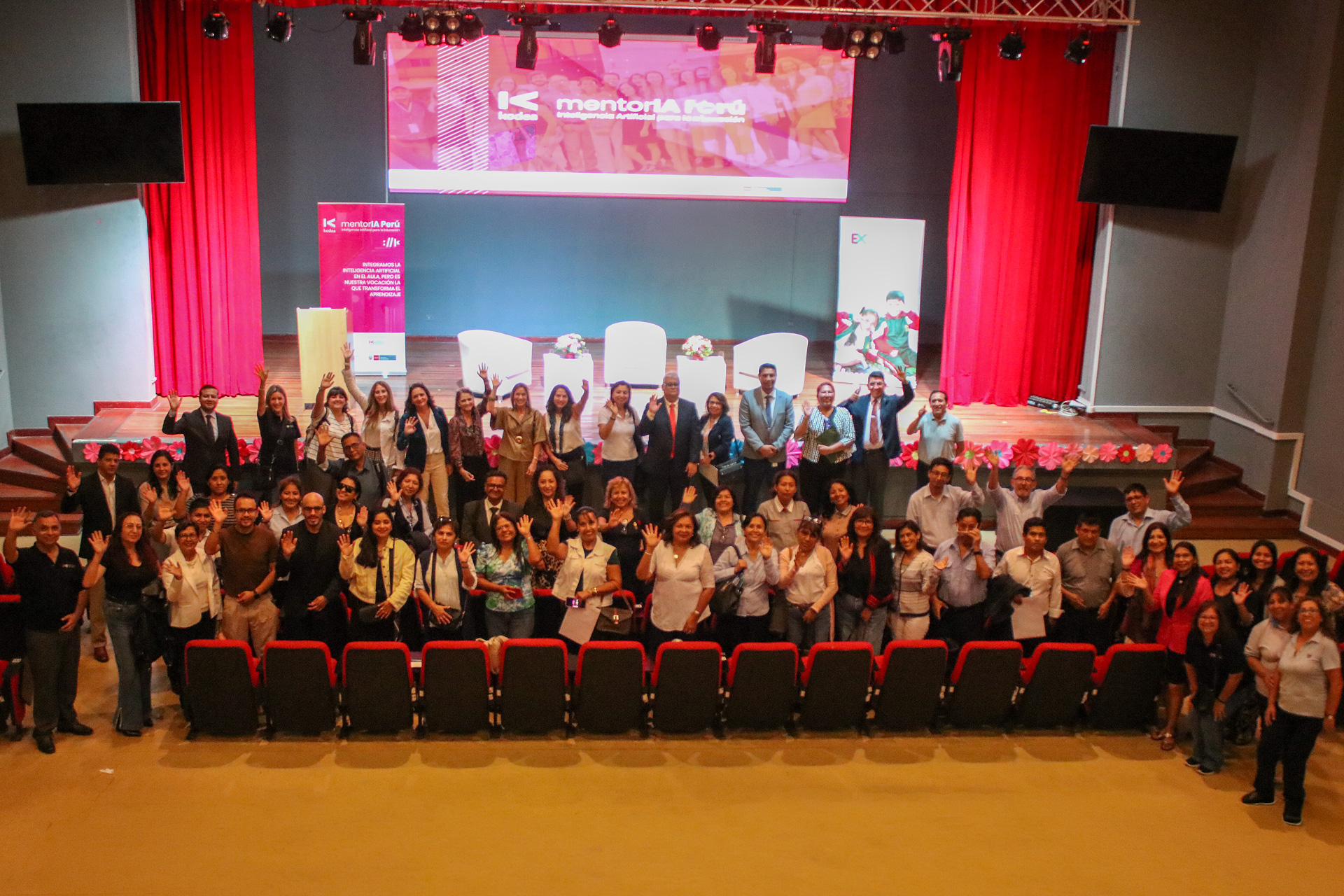
MentorIA Perú, run by Empresarios por la Educación and Fundación Kodea with Google.org funding and MINEDU support, trained 1,300+ teachers across Lima, Arequipa and Lambayeque, lifting average AI-knowledge test scores from 6.88 to 8.22 out of 9.
1,300+
Teachers trained (2025-2026)
50,000+
Students reached (2025-2026)
6.88 out of 9
AI-knowledge assessment score, before
8.22 out of 9
AI-knowledge assessment score, after
~50
Facilitators trained
Details
Maturity
Scaling
Promoter
Empresarios por la Educación (ExE) and Fundación Kodea, with funding from Google.org and support from Peru's Ministry of Education (MINEDU)
Period
2025–2026 (Phase 1); PerúEduca scale-up planned from 2026
Keywords
AI literacy, teacher professional development, digital skills, public-private partnership, primary and secondary education
Context
MentorIA Perú is a teacher AI-capacity-building programme implemented by the NGO Empresarios por la Educación (ExE) in alliance with Fundación Kodea, funded by Google.org and supported institutionally by Peru's Ministry of Education (MINEDU). It responds to a documented gap: as of 2025, 39% of Peru's public schools lacked digital-education access and 60% of the population aged 16-65 lacked basic digital skills.
Objectives
The programme set out to build teachers' AI knowledge and pedagogical application skills through a cascade-training model, aligned with Peru's national curriculum and incorporating tools such as Code.org.
Activities
Roughly 50 facilitators were trained first, then delivered cascade training in AI fundamentals and pedagogical applications to public-school teachers across three regions — Lima Metropolitana, Arequipa and Lambayeque. Between 2025 and 2026, MentorIA Perú trained more than 1,300 teachers, reaching over 50,000 students.
Results
Teachers' average score on an AI-knowledge assessment (0-9 scale) rose from 6.88 to 8.22, reported by Fundación Kodea as closing roughly two-thirds of the initial knowledge gap.
Conclusions
The knowledge-gain figure is a self-administered pre/post assessment reported by the implementing NGO, without an independent evaluator or comparison group, and reflects AI knowledge rather than verified classroom-practice change or student learning outcomes. From 2026, the programme is scheduled to integrate into PerúEduca, MINEDU's platform with more than 1 million registered users, to expand beyond the initial three regions.
Implementation
Indicative cost
Medium (€50k–€500k)
Time to results
Medium (1–3 years)
Staffing & skills
~50 trained facilitators delivering cascade training, Empresarios por la Educación (ExE) and Fundación Kodea programme staff
Conditions for success
Google.org funding
Institutional support and curriculum alignment from Peru's Ministry of Education (MINEDU)
Cascade-training model multiplying a small facilitator corps into 1,300+ trained teachers
Common failure modes
Self-reported pre/post assessment with no independent evaluator or control group
Coverage still limited to 3 of Peru's 26 regions
Commonly funded by
Philanthropic / foundation fundingNational / regional programmes
Indicative funding routes for practices of this type — always check each programme's current calls and eligibility rules.
Do you run this practice?
Claim it —
verified implementers get a public contact pathway and can propose corrections.
Data sources
Where this practice's information was retrieved from, and when.