Vietnam Women's Union Savings & Credit Groups — Mass-Organisation Microfinance for Rural Women
Vietnam
Since 1992, the Vietnam Women's Union has organised village-level Savings and Credit Groups channelling collateral-free loans to rural women via …
Tanzania · Chake Chake, Pemba · See the Tanzania profile
Evidence: Descriptive / self-reported Top 26% 85/100 · Ask Evidence Copilot about this practice
On Zanzibar's Pemba Island, where 88% of seaweed farmers are women, the NGO Aqua-Farms Organization lets women's cooperatives rent-to-own deep-water tubular-net equipment at 0% interest, lifting average farmer income from US$30 to US$80 a month for around 300 women.
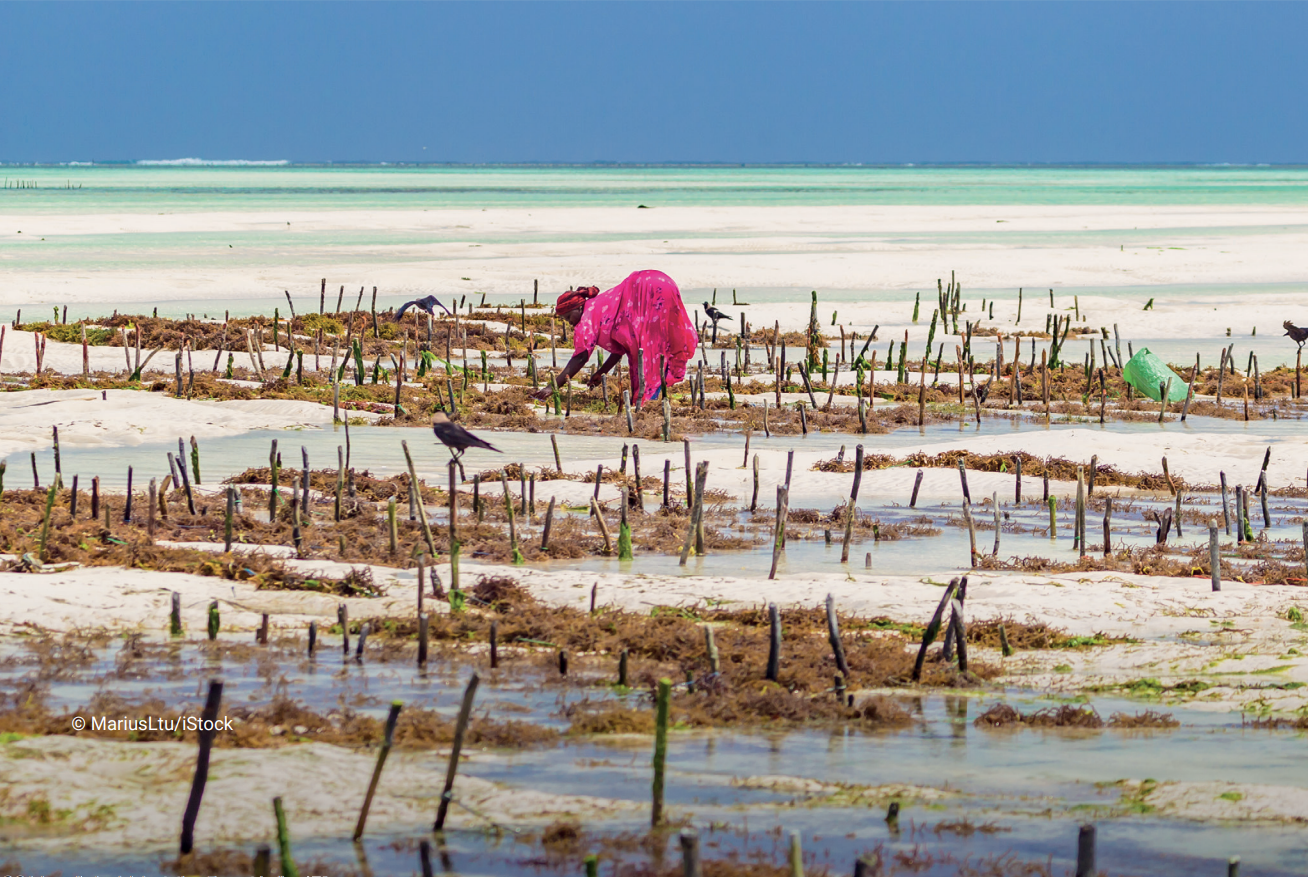
Zanzibar's seaweed sector employs more than 23,000 farmers, over 80% women, but shallow-water methods are vulnerable to warming seas and disease. Aqua-Farms Organization (AFO), a Tanzanian NGO founded in 2016, lets women's cooperatives on Pemba Island rent-to-own deep-water tubular-net equipment at 0% interest to move into cooler, more disease-resistant waters, with training in value-added products.
Average monthly income per farmer has risen from US$30 to US$80, per consistent figures from the Global Center on Adaptation and Maliasili. AFO's expansion plan aims to grow from two pilot cooperatives to ten (about 150 farmers), from 8 to 23 hectares under cultivation, targeting average income of US$140/month by 2026.
A separate, larger UN Joint SDG Fund programme launched in August 2025 for the same sector (targeting 15,000 households) has not yet reported results, underlining that Zanzibar's climate-driven seaweed crisis remains only partially addressed by any single initiative to date.
Implementation detail (cost, timeline, staffing, conditions for success) is not yet available for this practice.
Philanthropic / foundation funding
Indicative funding routes for practices of this type — always check each programme's current calls and eligibility rules.
Do you run this practice? Claim it — verified implementers get a public contact pathway and can propose corrections.
Where this practice's information was retrieved from, and when.
Vietnam
Since 1992, the Vietnam Women's Union has organised village-level Savings and Credit Groups channelling collateral-free loans to rural women via …
Malawi
CARE's Village Savings and Loan Associations (VSLAs) organise rural Malawian women into self-governing groups of 20–25. An IPA RCT found …
India
SEWA, founded in Ahmedabad in 1972, is the world's largest trade union of informal-sector women. With 3.7 million members across …
South Africa
Microloans for poor rural women combined with a gender and HIV curriculum in loan meetings. In a cluster-randomised trial, participants' …
Open full copilot Grounded in cited practices — always check the sources.