Bengaluru-based Thinkerbell Labs built Annie, an audio-guided, self-correcting braille teaching device that lets blind and low-vision students learn independently. Deployed in over …
Bengaluru, India
Good practice
Evidence: Descriptive / self-reported
Top 10%96/100
Nairobi's Signs Media Kenya broadcasts free Kenyan Sign Language content via Signs TV and, through its assistALL app, brought paid sign-language interpretation …
Nairobi, Kenya
Good practice
Evidence: Observational / pre–post
Top 24%92/100
Government-backed Indian digital library giving people with print disabilities free access to accessible-format books. Launched 2016 with 200,000+ titles; by its third …
New Delhi, India
Good practice
Evidence: Observational / pre–post
Top 24%92/100
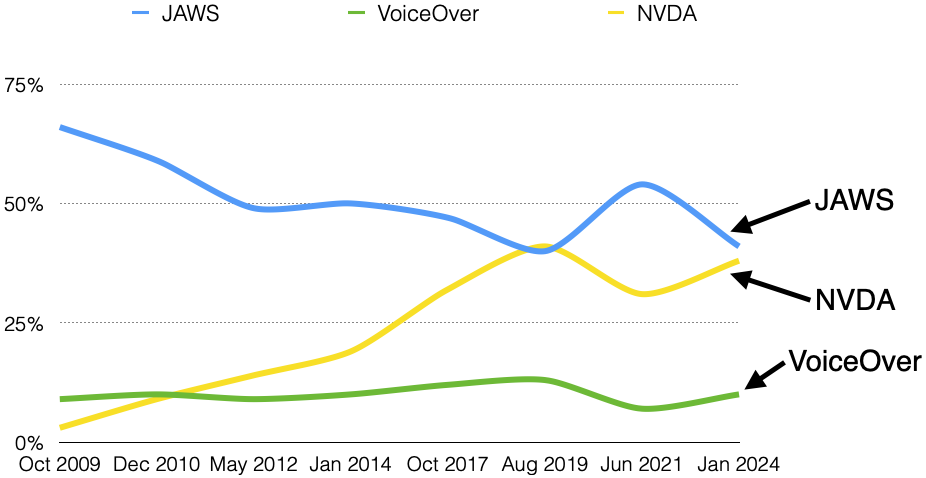
Free, open-source Windows screen reader from Australian non-profit NV Access. WebAIM's independent 2024 survey of 1,539 users found NVDA the most commonly …
Brisbane, Australia
Good practice
Evidence: Descriptive / self-reported
Top 24%92/100
eKitabu, a Nairobi edtech nonprofit, builds born-accessible e-books for blind/low-vision learners and Kenyan Sign Language video storybooks for deaf learners with Kenya's …
Azerbaijan's ASAN Xidmet one-stop-shop centres, launched in 2012 and backed by mobile 'ASAN' buses reaching rural areas, digitised dozens of services and …
Australia's government-funded National Relay Service added a dedicated Auslan Video Relay Service in 2013, letting Deaf people sign to a live interpreter …
Canberra, Australia
Good practice
Evidence: Descriptive / self-reported
Top 30%88/100
A peer-reviewed Fiji Ministry of Education study combined child-functioning survey data with learning-support-needs data in a rule-based algorithm that more accurately flags …
Suva, Fiji
Good practice
Evidence: Observational / pre–post
Top 39%76/100
Chang Gung University ran Taiwan's first feasibility and efficacy studies of eye-gaze assistive technology for children with severe motor and communication difficulties, …
Taoyuan, Taiwan
Good practice
Evidence: Randomised controlled trial
Top 6%73/100
STMicroelectronics Foundation, ITU and a blind Milan professor run train-the-trainer digital-literacy classes for blind and visually-impaired adults in Dakar. An advanced module …
Jamaica's 2022 pilot developed accessible digital storybooks tested in five schools—four for deaf, blind and intellectually disabled students. UNICEF's 10-country ADT programme; …
Eswatini's telecom-regulator-run Universal Access Service Fund has distributed thousands of subsidised smartphones and specialised assistive devices, reaching over 14,000 elderly people and …
Mbabane, Eswatini
Good practice
Evidence: Descriptive / self-reported
Top 55%72/100
A free government app gives Bahamians with disabilities one-touch access to emergency alerts, sign-language interpretation, job listings and transport bookings. Usage doubled …
Kuwait's UNDP-backed digital accessibility framework set WCAG-based e-government standards from 2018, but a 2023 peer-reviewed study found 77% of IT staff had …